Mahmood says revised settlement plans will save billions, but gives no total
Qualifying care workers will retain a five-year route to settlement, while the Home Office’s £10bn figure measured estimated lifetime costs under existing rules.
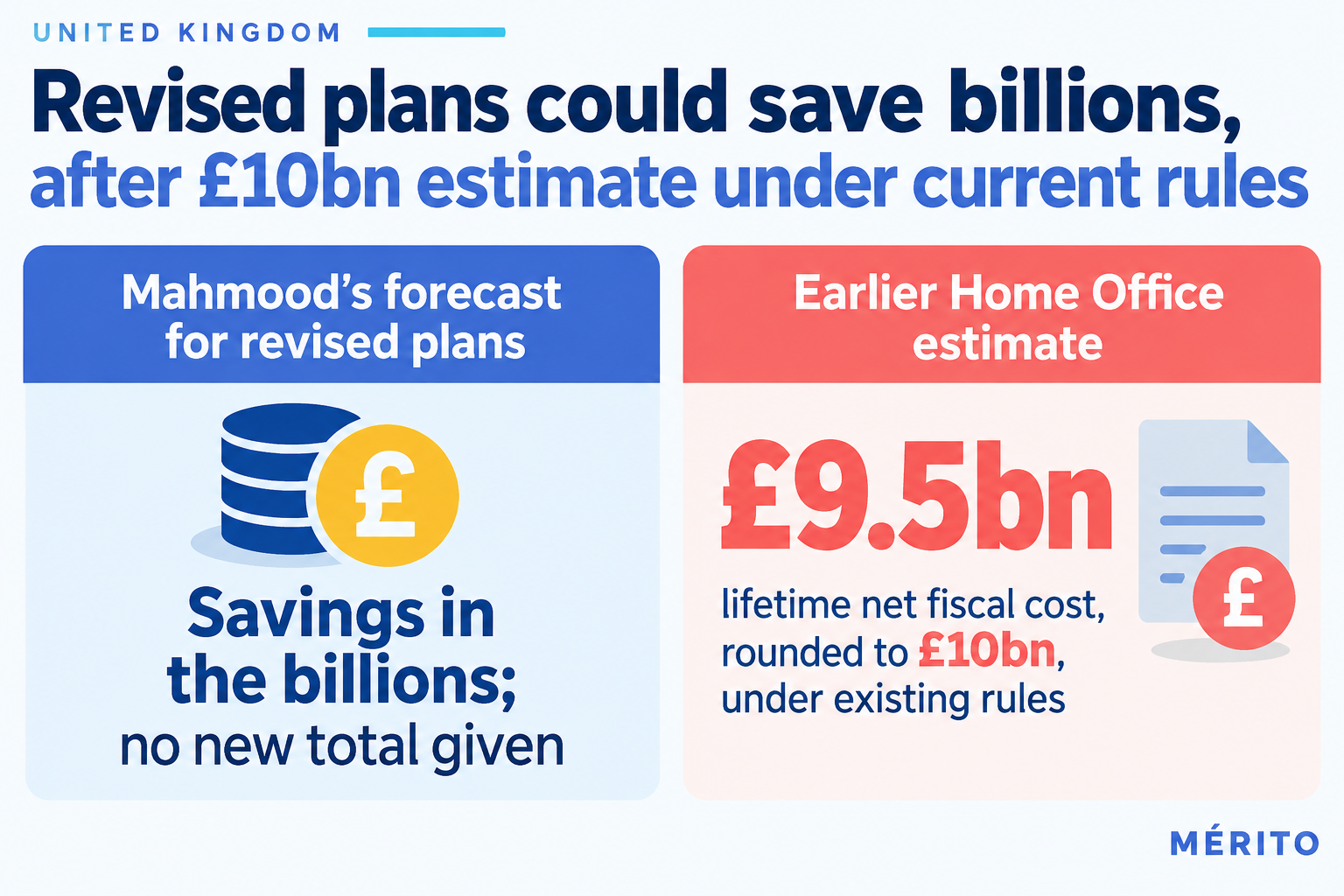
Home Secretary Shabana Mahmood says revised immigration settlement plans will still save billions in welfare spending, but has not provided a new estimate. The earlier £10bn figure was a modelled lifetime net fiscal cost under existing rules, not a calculation of savings from the changes.
The two figures describe different things: an unquantified savings expectation and an estimate of lifetime costs under existing settlement rules.
No revised savings figure yet
Shabana Mahmood said the revised settlement plans would still deliver savings in the billions, but she did not put a figure on them. She said the government would publish a full impact assessment when it lays the immigration rules before Parliament.
Mahmood said the expected savings would come in part from fewer benefit claims by care workers who are no longer working in the sector. The estimate for the revised policy remains unquantified in the material available; the earlier £10bn figure should not be treated as the amount the government expects the changes to save.
What the £10bn estimate measured
The Home Office’s March estimate put the lifetime net fiscal cost of care workers and their adult dependants expected to settle between 2026 and 2030 at £9.5bn, rounded to £10bn. It applied estimates of lifetime fiscal contributions to forecast numbers settling under the rules then in force.
The calculation combined an estimated £4.2bn net cost for 117,000 care-worker main applicants with £5.3bn for 79,000 adult dependants. The Home Office noted that some inputs relied on assumptions, including applying an occupational share to dependants because it could not match them to individual occupations. The UK Statistics Authority subsequently clarified that the £10bn was a cost estimate under existing rules, not a forecast of savings from delaying settlement.
Care workers retain a five-year route in specified cases
Under the revised plans announced on Monday, some foreign care workers who meet their visa conditions and earn at least £25,000 a year can still qualify for settlement after five years. Those who do not qualify for that route may apply for a further five-year visa and seek settlement after completing it.
The earlier proposal would have extended the usual wait for most migrants from five to 10 years, with some people facing 15 years. Mahmood said the revised policy would continue to lengthen settlement waits for many people, while allowing qualifying care workers to retain the five-year route. The planned impact assessment is intended to set out the expected effects of the final rules.
Explore the background
Further reading
Selected background resources to explain the context and concepts behind this story.
Understand what settlement and indefinite leave to remain mean in the UK, and how settlement grants and costs are discussed.
Migrant Settlement in the UK - Migration Observatory
This Migration Observatory briefing directly explains migrant settlement in the UK and covers how many people receive it and its costs, offering context for the article’s distinction between settlement rules and fiscal estimates.
Learn how UK visa and settlement policy proposals relate to the immigration rules and when a proposal changes the law.
Changes to UK visa and settlement rules after the 2025 ...
The House of Commons Library briefing explains that a white paper does not itself alter the law or immigration rules, helping readers distinguish policy proposals from rules in force.
Learn about the Migration Advisory Committee’s purpose and governance as a source of immigration-policy advice.
Review of the Migration Advisory Committee
The deposited parliamentary review describes the MAC secretariat’s support and governance role, giving institutional context for the committee named in the article.
External links selected for their educational value. They are separate from the sources used to report this story.
Editorial transparency
Article integrity
These checks apply to the published version. Changes to its content or evidence require a fresh review.
Veracidad
Aprobado
Comprueba que la pieza tenga fuentes declaradas y verificadas, que el nivel de evidencia se presente correctamente y que el desarrollo sea suficiente para sostener sus afirmaciones.
100/100
Analizado 04/11/2026 03:34 · rules-v1
Ausencia de sesgo
Aprobado
Busca lenguaje emocional, descalificaciones, generalizaciones absolutas y una voz editorial impropia de una noticia. También comprueba atribuciones y pluralidad de fuentes cuando la materia es sensible.
100/100
Analizado 04/11/2026 03:34 · rules-v1
Ausencia de clickbait
Aprobado
Evalúa si el titular cuenta el hecho principal sin ocultarlo para provocar curiosidad, sin promesas exageradas y sin recursos tipográficos engañosos.
100/100
Analizado 04/11/2026 03:34 · rules-v1
Coherencia editorial
Aprobado
Contrasta titular, subtítulo, resumen y cuerpo para detectar contradicciones, cifras sin respaldo o un alcance mayor del que permite la información disponible.
100/100
Analizado 04/11/2026 03:34 · rules-v1
Plagio y originalidad
Aprobado
Compara la prosa con los extractos de las fuentes utilizadas y con hasta 250 publicaciones recientes de Mérito para detectar copia extensa o una reescritura demasiado cercana.
100/100
Analizado 04/11/2026 03:34 · rules-v1
Conflictos de interés
Aprobado
Analiza posibles relaciones entre la autoría, el medio y las fuentes, así como patrocinio, lenguaje promocional o dependencia exclusiva de comunicados de prensa.
100/100
Analizado 04/11/2026 03:34 · rules-v1
The score is a quality-control indicator, not a probability that something is true.