Independent review announced into Henry Nowak’s murder
The review led by Alex Chalk KC will examine possible prevention opportunities and the treatment of the Nowak family; the IOPC is separately investigating two officers for potential gross misconduct.
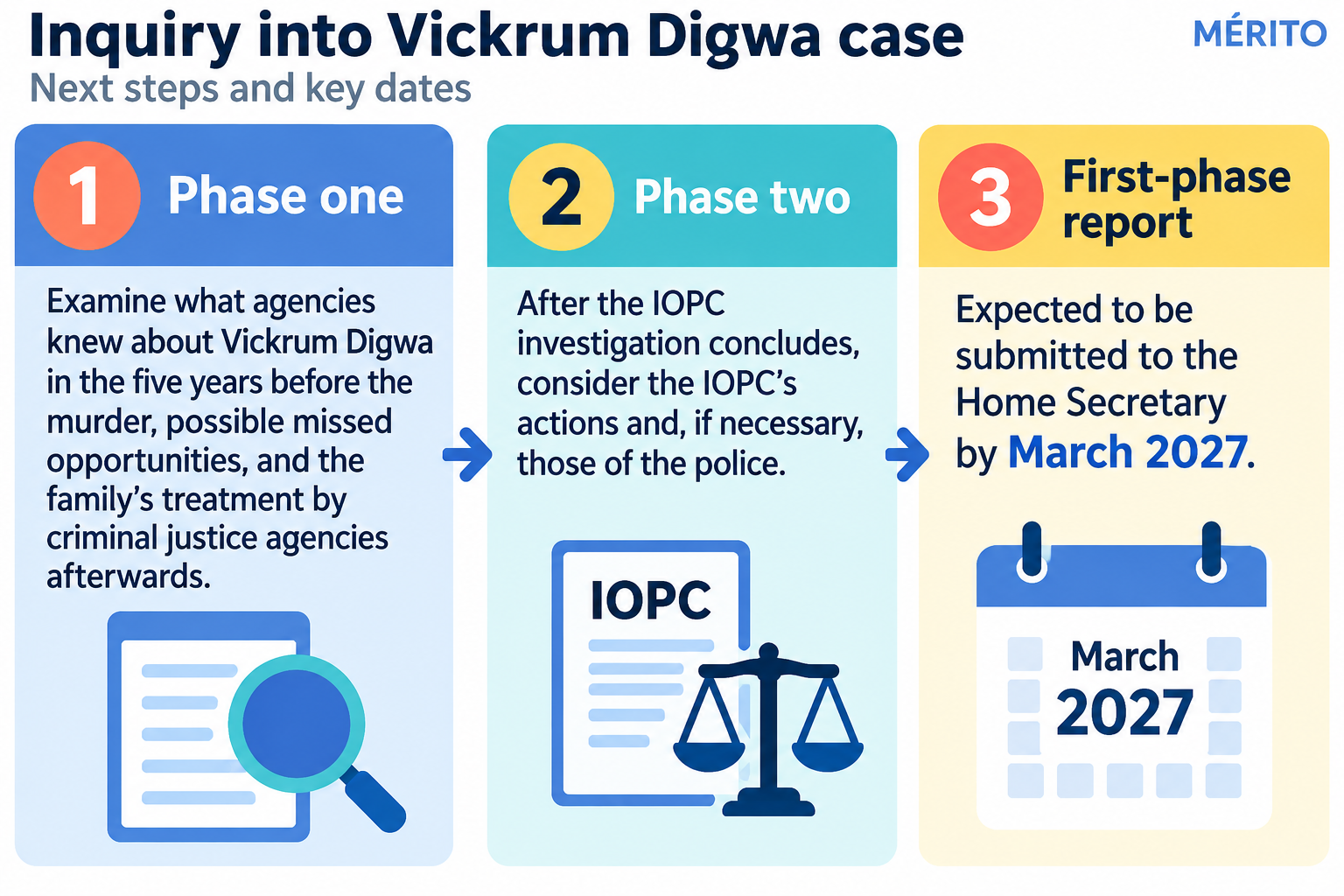
The review’s first phase is to examine what agencies knew about Vickrum Digwa in the five years before Henry Nowak’s murder and how the family was treated by criminal justice agencies afterwards. A second phase will follow the IOPC investigation into officers who attended the scene. The Nowak family called the review a significant moment in their pursuit of justice, while saying they still wanted answers, accountability and meaningful change. The first-phase report was expected by March 2027.
The announced remit sets out a first phase and a later phase following the IOPC investigation.
A two-phase review
The Home Secretary announced an independent review into Henry Nowak’s murder and appointed former Lord Chancellor Alex Chalk KC to lead it. The first phase will examine whether opportunities were missed to prevent the murder, including what agencies knew about Vickrum Digwa in the five years before the attack.
The first phase covers the police, health services, local authorities, educational institutions and faith organisations. It will consider whether concerns had been raised about weapon possession or violent, threatening and erratic behaviour. It will also examine how agencies across the criminal justice system treated the Nowak family after Henry’s death, including the police, the Crown Prosecution Service, HM Courts and Tribunals Service, and HM Prison and Probation Service.
The remit sets out questions for examination; it does not establish that an agency missed an opportunity or determine responsibility. The first-phase report was expected to be submitted to the Home Secretary by March 2027.
The IOPC investigation and the family’s response
The second phase is to follow after the Independent Office for Police Conduct (IOPC) completes its investigation into officers who attended the scene. It will consider the IOPC’s actions and, if necessary, those of the police. In a separate update, the IOPC said two Hampshire and Isle of Wight Constabulary officers were under investigation for potential gross misconduct. The concerns included possible failures to recognise that Henry needed urgent medical attention and to act after he said he had been stabbed and could not breathe, as well as the decision to arrest and handcuff him rather than provide immediate first aid. The IOPC said the investigation had not concluded; the notices did not mean disciplinary proceedings would necessarily follow.
The Nowak family welcomed the review, describing its announcement as “a significant moment in our fight for justice”. They said they still wanted answers, accountability and meaningful change, and that there was a long road ahead. These were the family’s stated hopes; they were not findings of the review.
Explore the background
Further reading
Selected background resources to explain the context and concepts behind this story.
Understand the IOPC’s role in police complaints and serious-conduct investigations in England and Wales.
Independent Office for Police Conduct - Wikipedia
The article distinguishes the IOPC investigation into officers from the independent review. This reference explains the body’s remit and how it fits into police accountability.
External links selected for their educational value. They are separate from the sources used to report this story.
Editorial transparency
Article integrity
These checks apply to the published version. Changes to its content or evidence require a fresh review.
Veracidad
Aprobado
Comprueba que la pieza tenga fuentes declaradas y verificadas, que el nivel de evidencia se presente correctamente y que el desarrollo sea suficiente para sostener sus afirmaciones.
100/100
Analizado 27/10/2026 00:28 · rules-v1
Ausencia de sesgo
Aprobado
Busca lenguaje emocional, descalificaciones, generalizaciones absolutas y una voz editorial impropia de una noticia. También comprueba atribuciones y pluralidad de fuentes cuando la materia es sensible.
100/100
Analizado 27/10/2026 00:28 · rules-v1
Ausencia de clickbait
Aprobado
Evalúa si el titular cuenta el hecho principal sin ocultarlo para provocar curiosidad, sin promesas exageradas y sin recursos tipográficos engañosos.
100/100
Analizado 27/10/2026 00:28 · rules-v1
Coherencia editorial
Aprobado
Contrasta titular, subtítulo, resumen y cuerpo para detectar contradicciones, cifras sin respaldo o un alcance mayor del que permite la información disponible.
100/100
Analizado 27/10/2026 00:28 · rules-v1
Plagio y originalidad
Aprobado
Compara la prosa con los extractos de las fuentes utilizadas y con hasta 250 publicaciones recientes de Mérito para detectar copia extensa o una reescritura demasiado cercana.
100/100
Analizado 27/10/2026 00:28 · rules-v1
Conflictos de interés
Aprobado
Analiza posibles relaciones entre la autoría, el medio y las fuentes, así como patrocinio, lenguaje promocional o dependencia exclusiva de comunicados de prensa.
100/100
Analizado 27/10/2026 00:28 · rules-v1
The score is a quality-control indicator, not a probability that something is true.