Revised UK settlement plan keeps five-year route for some care workers
Shabana Mahmood says the changes will still deliver savings; Anna Turley estimates at least £1bn in welfare savings over the next few years, pending further calculations.
Some migrant care workers will remain eligible to apply for settlement after five years under revised UK plans, while others will have to wait longer. Mahmood’s original proposals would have extended the standard wait to 10 years, with some workers facing 15 years. The revised plan’s overall fiscal effect has not been assessed publicly.
The revised arrangements set out different routes to settlement for migrant care workers.
What the revised arrangements say
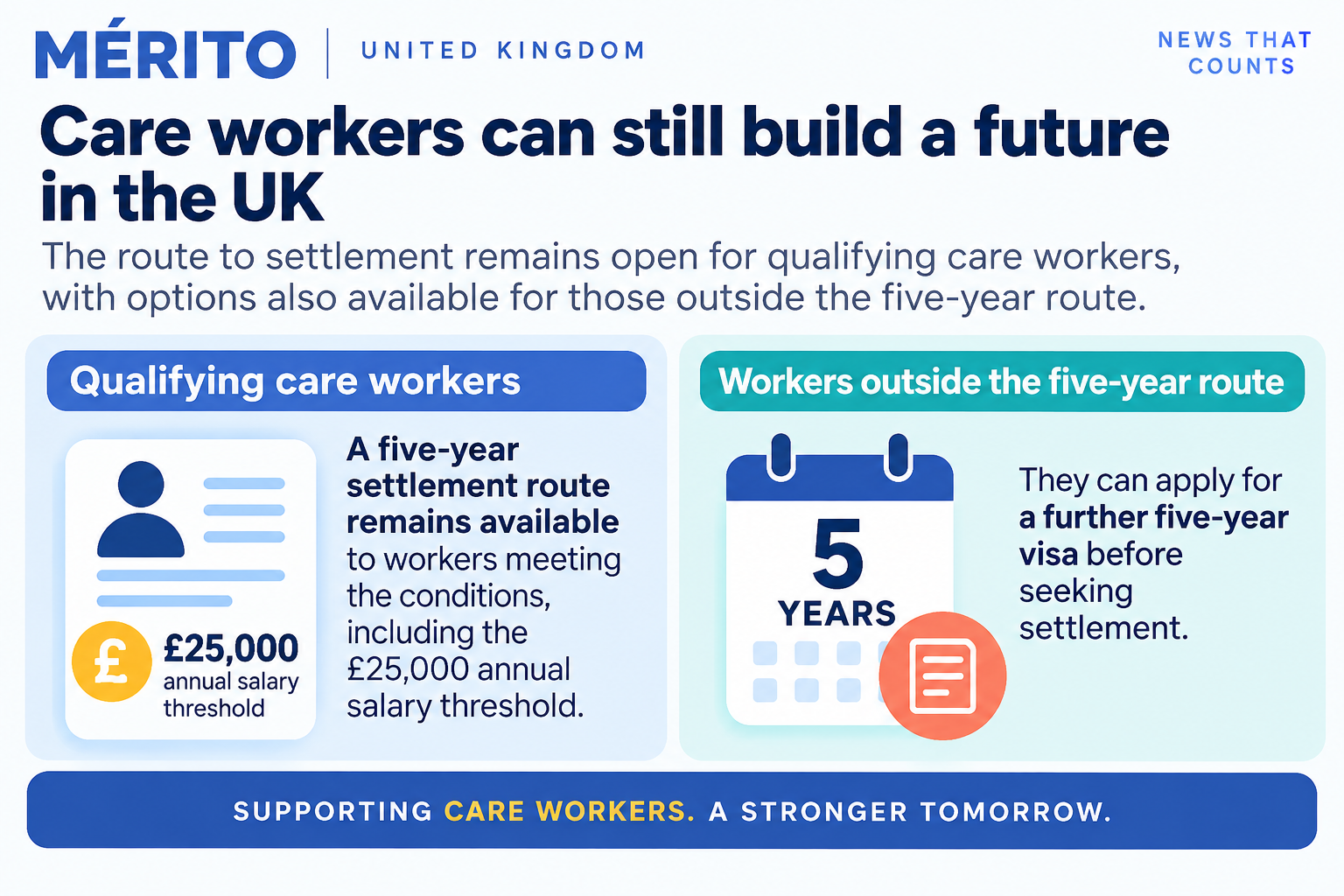
Under the revised UK settlement arrangements, some migrant care workers can still apply for settlement after five years if they meet the qualifying conditions, including earning at least £25,000 a year.
Care workers who do not qualify for that route can apply for a further five-year visa and then seek settlement after completing it. The wider earned-settlement proposals make settlement conditional rather than automatic after the standard qualifying period.
How the original proposal changed
Mahmood’s original proposals would have extended the standard settlement wait from five years to 10, with some migrants facing a 15-year wait. The revised arrangements preserve a five-year route for qualifying care workers and provide a further five-year visa option for others.
The revised arrangements are expected to delay settlement for just over 500,000 people, according to Home Office figures reported at the time. Mahmood described the changes as significant while saying the revised package reflected the consultation and the contribution of people who came to work in care.
Ministers set out their savings rationale
Mahmood said the changes would reduce welfare spending in part by preventing care workers who were no longer working in the sector from securing settlement after five years and then claiming benefits. She described those workers as a group more likely to rely on state support, while saying that people outside the five-year route would have another opportunity to contribute before seeking settlement.
Home Office minister Anna Turley estimated that the revised plan would save at least £1bn in welfare spending over the next couple of years, but said further calculations were still needed. Mahmood has not provided a new overall total and said a detailed impact assessment would be published when the immigration rules are presented to Parliament.
The separate £10bn figure was an estimate of net lifetime fiscal costs associated with care workers and their adult dependants expected to settle between 2026 and 2030 under existing rules. It was not an assessed savings figure for the revised arrangements. The Home Office has said the final arrangements will be subject to economic and equality impact assessments.
Explore the background
Further reading
Selected background resources to explain the context and concepts behind this story.
Understand how UK decision-makers assess continuous residence in applications for indefinite leave to remain.
Continuous residence
This Home Office guidance explains the continuous-residence requirements relevant to settlement applications, providing a useful procedural complement to the article’s discussion of qualifying for settlement.
Learn which UK government department is responsible for immigration, asylum, nationality and border-control policy.
Constituency casework: Immigration, asylum and nationality
The parliamentary briefing identifies the Home Office’s lead responsibilities, helping readers place the settlement proposals within the government’s institutional framework.
Identify Shabana Mahmood’s official ministerial role and the responsibilities attached to it.
The Rt Hon Shabana Mahmood MP
The GOV.UK biography states that Mahmood is Secretary of State for the Home Department and outlines the portfolio, helping readers understand her position in the policy debate.
External links selected for their educational value. They are separate from the sources used to report this story.
Editorial transparency
Article integrity
These checks apply to the published version. Changes to its content or evidence require a fresh review.
Veracidad
Aprobado
Comprueba que la pieza tenga fuentes declaradas y verificadas, que el nivel de evidencia se presente correctamente y que el desarrollo sea suficiente para sostener sus afirmaciones.
100/100
Analizado 04/11/2026 02:30 · rules-v1
Ausencia de sesgo
Aprobado
Busca lenguaje emocional, descalificaciones, generalizaciones absolutas y una voz editorial impropia de una noticia. También comprueba atribuciones y pluralidad de fuentes cuando la materia es sensible.
100/100
Analizado 04/11/2026 02:30 · rules-v1
Ausencia de clickbait
Aprobado
Evalúa si el titular cuenta el hecho principal sin ocultarlo para provocar curiosidad, sin promesas exageradas y sin recursos tipográficos engañosos.
100/100
Analizado 04/11/2026 02:30 · rules-v1
Coherencia editorial
Aprobado
Contrasta titular, subtítulo, resumen y cuerpo para detectar contradicciones, cifras sin respaldo o un alcance mayor del que permite la información disponible.
100/100
Analizado 04/11/2026 02:30 · rules-v1
Plagio y originalidad
Aprobado
Compara la prosa con los extractos de las fuentes utilizadas y con hasta 250 publicaciones recientes de Mérito para detectar copia extensa o una reescritura demasiado cercana.
100/100
Analizado 04/11/2026 02:30 · rules-v1
Conflictos de interés
Aprobado
Analiza posibles relaciones entre la autoría, el medio y las fuentes, así como patrocinio, lenguaje promocional o dependencia exclusiva de comunicados de prensa.
100/100
Analizado 04/11/2026 02:30 · rules-v1
The score is a quality-control indicator, not a probability that something is true.