Youth Jobs Guarantee to expand nationwide, with eligibility threshold cut to 12 months
The scheme is set to offer eligible 18–24-year-olds up to six months of paid work, with Government funding for up to 25 hours a week at the relevant minimum wage.
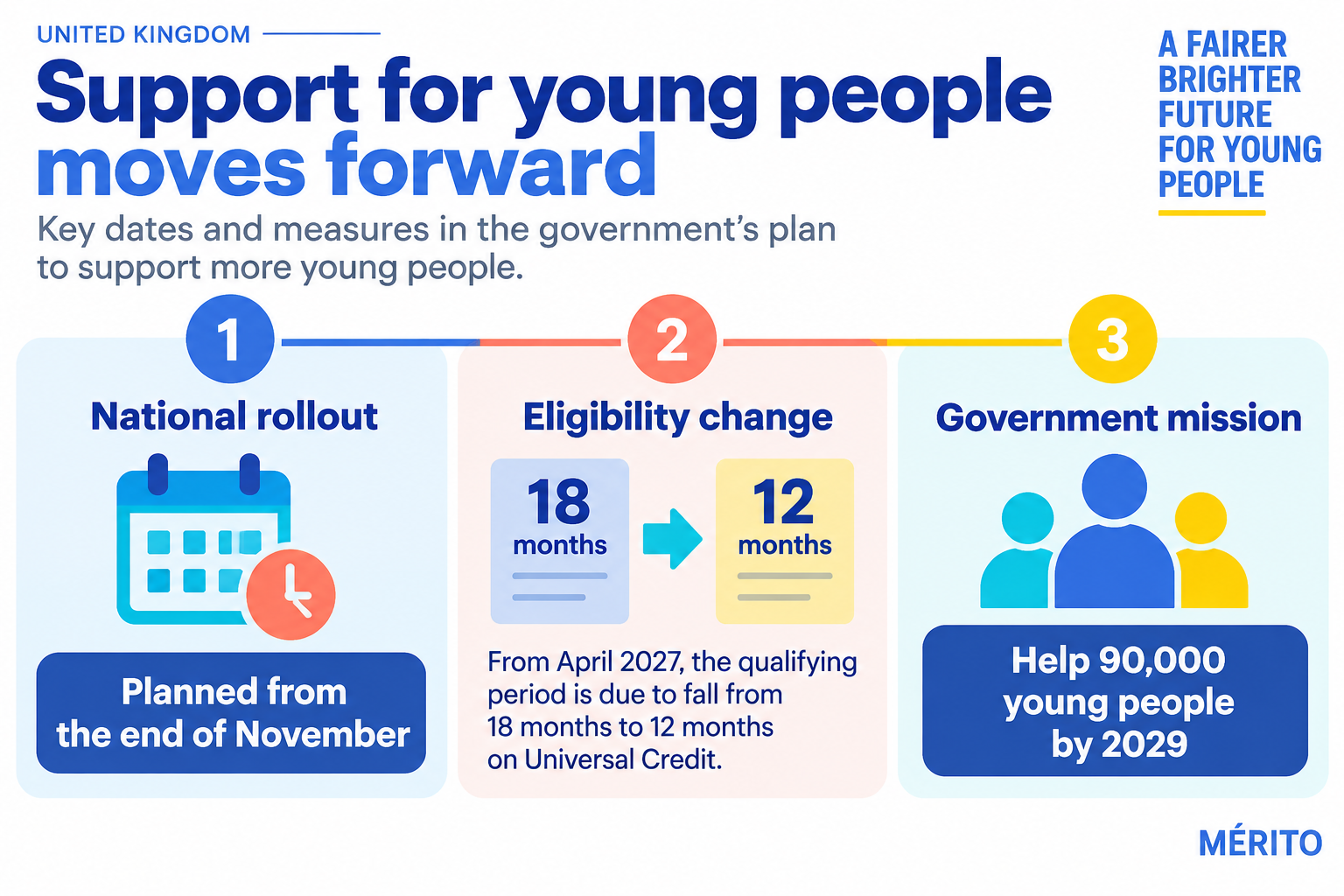
The Government plans to roll out its Jobs Guarantee across Great Britain from the end of November. From April 2027, eligible young people will be able to qualify after 12 months on Universal Credit, down from 18 months. The stated mission is to help 90,000 young people by 2029.
The rollout and eligibility change are planned for separate stages; the 90,000 figure is the Government’s stated mission.
What the expanded scheme offers
The Government’s Jobs Guarantee is due to expand across Great Britain for eligible people aged 18 to 24. Placements are intended to match participants’ skills and last six months.
The Government will fund up to 25 hours of paid work a week at the relevant minimum wage. The national rollout is planned to begin at the end of November, while the change to eligibility is scheduled for a later date.
The Government’s stated mission is to help 90,000 young people by 2029. The expansion follows a trial in six areas with high youth unemployment, including Greater Manchester and South West Wales.
Eligibility changes in April 2027
From April 2027, the period a young person must have claimed Universal Credit before qualifying is due to fall from 18 months to 12 months. The stated purpose of the change is to bring more claimants within reach of the subsidised placements; the available sources do not establish how many additional people will take them up.
The scheme’s name does not create a legal entitlement to a job. Alan Milburn has separately argued for a legal duty to ensure young people can access work, training or employment support. That proposal is distinct from the Jobs Guarantee expansion announced by the Department for Work and Pensions.
Explore the background
Further reading
Selected background resources to explain the context and concepts behind this story.
Understand the legislative and policy context of the Jobs Guarantee scheme, including its origins and current eligibility criteria.
Youth Guarantee - The House of Commons Library
The House of Commons Library provides an authoritative, non-partisan overview of the scheme, explaining how it fits into broader UK employment policy and detailing the specific parameters (such as the 18-month Universal Credit threshold) that are being modified in the news.
Gain a clear understanding of how Universal Credit functions as a benefit system and its rollout history in Great Britain.
Universal Credit roll-out: 2018-19 - House of Commons Library
Since the Jobs Guarantee eligibility is tied to the duration of Universal Credit claims, this briefing from the House of Commons Library offers essential background on the benefit's structure and implementation, helping readers understand the administrative framework the new scheme relies on.
Learn the standard international definitions and metrics used to measure youth employment and unemployment.
Concepts and definitions of employment indicators relevant ...
The ILO document provides the technical vocabulary and statistical standards for youth labour market indicators, enabling readers to critically evaluate the '90,000 young people' target and understand how such outcomes are typically monitored and defined globally.
Review the specific operational guidelines and funding mechanisms for employers participating in the Jobs Guarantee.
Jobs Guarantee – Phase One Grant Guidance January 2026
This official government guidance document details the practical aspects of the scheme, such as the six-month duration and funding for paid hours, offering a concrete look at how the policy is intended to be delivered on the ground.
External links selected for their educational value. They are separate from the sources used to report this story.
Editorial transparency
Article integrity
These checks apply to the published version. Changes to its content or evidence require a fresh review.
Veracidad
Aprobado
Comprueba que la pieza tenga fuentes declaradas y verificadas, que el nivel de evidencia se presente correctamente y que el desarrollo sea suficiente para sostener sus afirmaciones.
100/100
Analizado 15/11/2026 06:30 · rules-v1
Ausencia de sesgo
Aprobado
Busca lenguaje emocional, descalificaciones, generalizaciones absolutas y una voz editorial impropia de una noticia. También comprueba atribuciones y pluralidad de fuentes cuando la materia es sensible.
100/100
Analizado 15/11/2026 06:30 · rules-v1
Ausencia de clickbait
Aprobado
Evalúa si el titular cuenta el hecho principal sin ocultarlo para provocar curiosidad, sin promesas exageradas y sin recursos tipográficos engañosos.
100/100
Analizado 15/11/2026 06:30 · rules-v1
Coherencia editorial
Aprobado
Contrasta titular, subtítulo, resumen y cuerpo para detectar contradicciones, cifras sin respaldo o un alcance mayor del que permite la información disponible.
100/100
Analizado 15/11/2026 06:30 · rules-v1
Plagio y originalidad
Aprobado
Compara la prosa con los extractos de las fuentes utilizadas y con hasta 250 publicaciones recientes de Mérito para detectar copia extensa o una reescritura demasiado cercana.
100/100
Analizado 15/11/2026 06:30 · rules-v1
Conflictos de interés
Aprobado
Analiza posibles relaciones entre la autoría, el medio y las fuentes, así como patrocinio, lenguaje promocional o dependencia exclusiva de comunicados de prensa.
100/100
Analizado 15/11/2026 06:30 · rules-v1
The score is a quality-control indicator, not a probability that something is true.