Inquest finds singer Lauren Bennett died by suicide
The 36-year-old, who featured on “Party Rock Anthem”, was found in woodland near her home in Kent on 29 May 2026.
An inquest at Kent and Medway Coroners’ Court found that Lauren Bennett died by suicide. The singer had been receiving specialist mental health care after a crisis in January, the court heard.
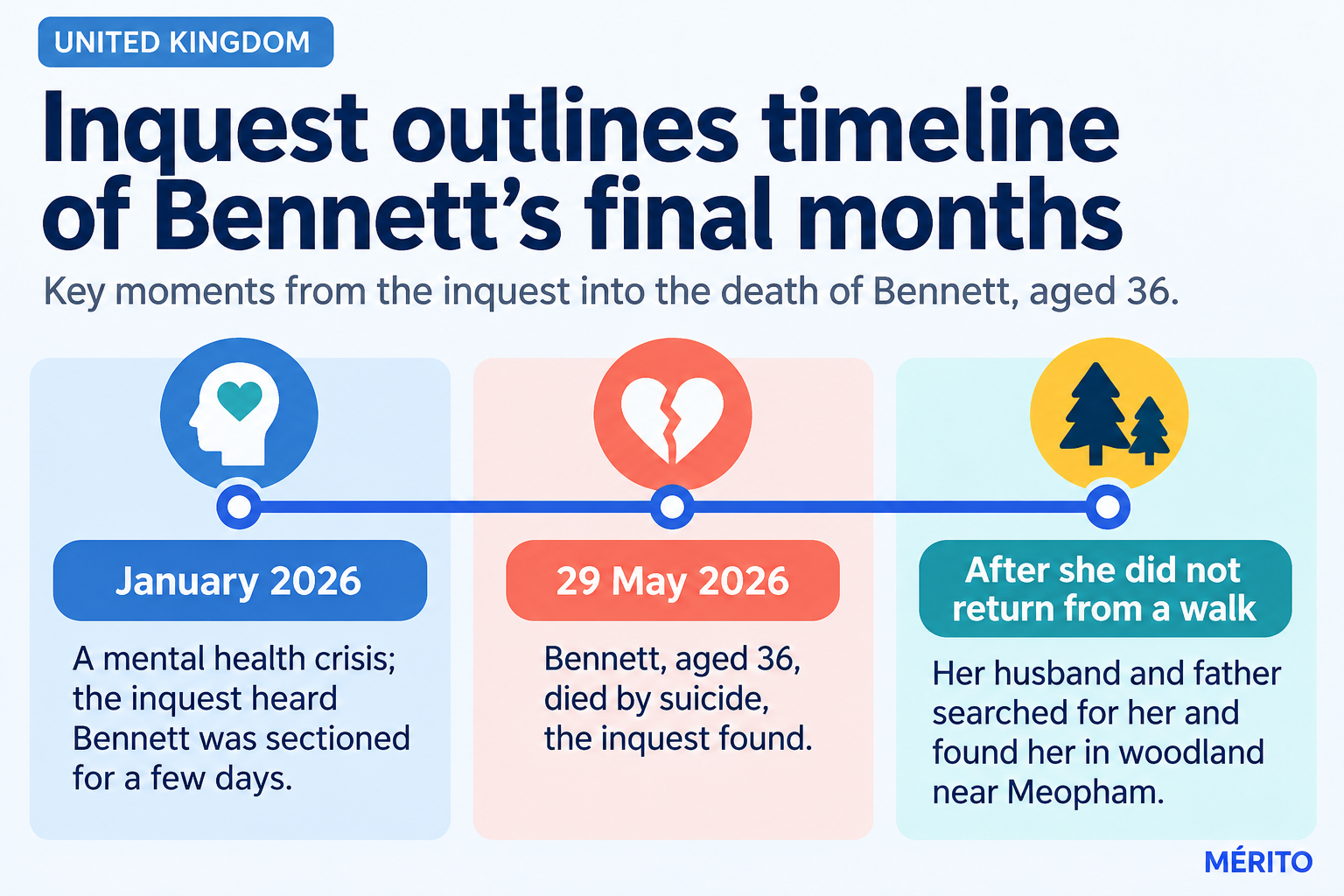
The timeline summarises the inquest finding and the sequence of events reported to the court.
What the inquest found
An inquest at Kent and Medway Coroners’ Court found that Lauren Bennett died by suicide on 29 May 2026. Bennett was 36. Assistant coroner Jyoti Gill recorded that she died by hanging.
Gill said Bennett had experienced substantial psychological suffering since a mental health crisis in January, when she was sectioned for a few days. She was in the care of specialist mental health services at the time of her death, the court heard.
The search near Meopham
Bennett told her husband, Kenny Wormald, that she was going for a walk on the morning of her death. When she did not return, Wormald and her father went looking for her and found her in woodland near her home in Meopham, Kent.
The inquest heard that Bennett had met with mental health services days before she died and had continued to report distress about the effects of prescribed medication. The court reports do not establish that medication or any particular aspect of her care caused her death.
Her music career
Bennett was a member of the girl group G.R.L. and featured on LMFAO’s 2011 hit Party Rock Anthem. The inquest coverage identified her through that recording and her work with the group.
Explore the background
Further reading
Selected background resources to explain the context and concepts behind this story.
Understand the role of Kent’s Coroner Service in conducting inquests.
(Public Pack)Agenda Document for Cabinet, 15/03/2021 10:00
The extract mentions the service and a jury inquest, offering local institutional context; it does not explain the findings in Lauren Bennett’s case.
External links selected for their educational value. They are separate from the sources used to report this story.
Editorial transparency
Article integrity
These checks apply to the published version. Changes to its content or evidence require a fresh review.
Veracidad
Aprobado
Comprueba que la pieza tenga fuentes declaradas y verificadas, que el nivel de evidencia se presente correctamente y que el desarrollo sea suficiente para sostener sus afirmaciones.
100/100
Analizado 31/10/2026 06:22 · rules-v1
Ausencia de sesgo
Aprobado
Busca lenguaje emocional, descalificaciones, generalizaciones absolutas y una voz editorial impropia de una noticia. También comprueba atribuciones y pluralidad de fuentes cuando la materia es sensible.
100/100
Analizado 31/10/2026 06:22 · rules-v1
Ausencia de clickbait
Aprobado
Evalúa si el titular cuenta el hecho principal sin ocultarlo para provocar curiosidad, sin promesas exageradas y sin recursos tipográficos engañosos.
100/100
Analizado 31/10/2026 06:22 · rules-v1
Coherencia editorial
Aprobado
Contrasta titular, subtítulo, resumen y cuerpo para detectar contradicciones, cifras sin respaldo o un alcance mayor del que permite la información disponible.
100/100
Analizado 31/10/2026 06:22 · rules-v1
Plagio y originalidad
Aprobado
Compara la prosa con los extractos de las fuentes utilizadas y con hasta 250 publicaciones recientes de Mérito para detectar copia extensa o una reescritura demasiado cercana.
100/100
Analizado 31/10/2026 06:22 · rules-v1
Conflictos de interés
Aprobado
Analiza posibles relaciones entre la autoría, el medio y las fuentes, así como patrocinio, lenguaje promocional o dependencia exclusiva de comunicados de prensa.
100/100
Analizado 31/10/2026 06:22 · rules-v1
The score is a quality-control indicator, not a probability that something is true.