Florida judge allows Trump’s defamation case against BBC to proceed
Jeffrey Kuntz rejected the BBC’s bid to dismiss the claim over a Panorama edit, but dismissed Trump’s separate Florida trade-practices claim.
A federal judge in Florida has allowed Donald Trump’s defamation claim against the BBC to proceed over the editing of his 6 January 2021 speech in a 2024 Panorama documentary. The decision does not establish that the BBC defamed Trump or that he can prove damages.
The ruling keeps the defamation claim alive but does not decide whether it can be proved.
The defamation claim moves forward
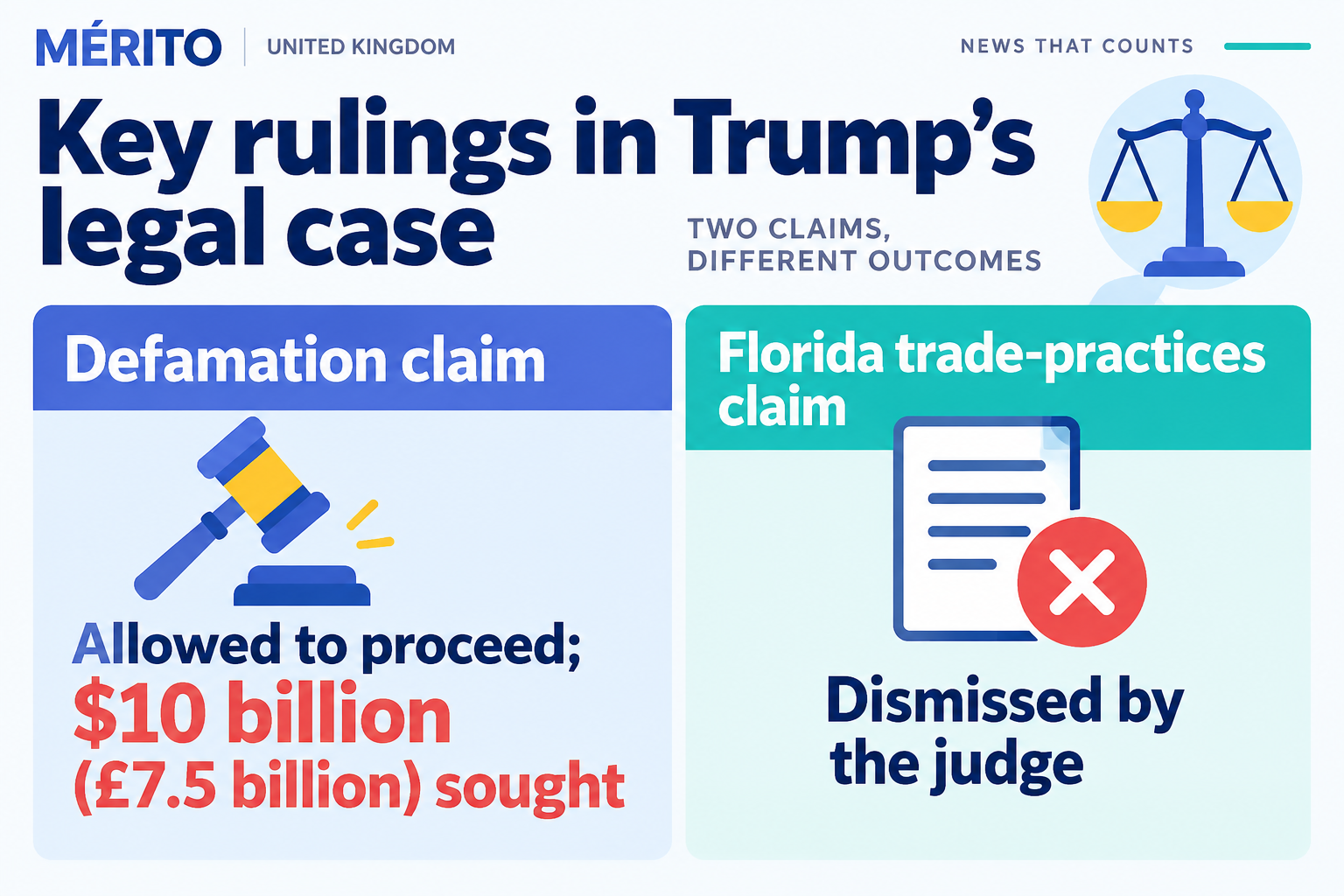
On Tuesday, 10 November, US District Judge Jeffrey Kuntz allowed Donald Trump’s defamation claim against the BBC to proceed, rejecting the broadcaster’s request to dismiss it. The lawsuit seeks $10 billion (£7.5 billion) over the editing of a 2024 episode of Panorama, titled Trump: A Second Chance.
The dispute concerns the programme’s use of two sections of Trump’s speech on 6 January 2021, before the attack on the US Capitol. The sections were nearly 55 minutes apart, according to the judge’s account in the ruling. The BBC apologised for the edit, saying the broadcast gave the mistaken impression that Trump had made a direct call for violent action.
The ruling is not a decision on the merits
The judge found that Trump had pleaded a plausible defamation claim, including an allegation of reputational harm. That is a decision about whether the case can continue, not a finding that the BBC is liable. Trump still has to prove his allegations and establish damages in later proceedings.
Kuntz also dismissed Trump’s separate claim under Florida’s Deceptive and Unfair Trade Practices Act. The case therefore continues on the defamation claim, while that consumer-law claim has been removed.
Both sides say the case will continue
The BBC said it was surprised by the decision, respected the court’s authority and remained confident in its position. Trump described the ruling as a victory in a post on Truth Social. Those responses do not change the limited scope of the decision: the court has not determined whether the edit was defamatory.
Explore the background
Further reading
Selected background resources to explain the context and concepts behind this story.
Understand the legal framework governing defamation claims in England and Wales, including defenses and procedural requirements.
Defamation Act 2013
The Defamation Act 2013 provides the statutory basis for defamation litigation in the UK, outlining what constitutes a defamatory statement, the burden of proof, and available defenses such as truth and honest opinion. This is essential for grasping the merits of Trump’s claim against the BBC within UK law.
Learn about the structure, governance, and public service mandate of the British Broadcasting Corporation (BBC).
BBC - Wikipedia
The BBC’s official profile explains its role as a public service broadcaster, its funding model, and editorial standards. This context helps readers assess how the BBC’s production processes might intersect with defamation concerns.
Explore the scope and application of Florida’s Deceptive and Unfair Trade Practices Act (FDUTPA) as it relates to defamation cases.
State Antitrust Statutes Bound by Their Original Scope
The FDUTPA text clarifies the legal basis for Florida claims of deceptive practices, including how it was invoked in Trump’s separate claim. Understanding its provisions is key to evaluating the judge’s dismissal of that claim and the remaining defamation claim.
External links selected for their educational value. They are separate from the sources used to report this story.
Editorial transparency
Article integrity
These checks apply to the published version. Changes to its content or evidence require a fresh review.
Veracidad
Aprobado
Comprueba que la pieza tenga fuentes declaradas y verificadas, que el nivel de evidencia se presente correctamente y que el desarrollo sea suficiente para sostener sus afirmaciones.
100/100
Analizado 11/11/2026 02:36 · rules-v1
Ausencia de sesgo
Aprobado
Busca lenguaje emocional, descalificaciones, generalizaciones absolutas y una voz editorial impropia de una noticia. También comprueba atribuciones y pluralidad de fuentes cuando la materia es sensible.
100/100
Analizado 11/11/2026 02:36 · rules-v1
Ausencia de clickbait
Aprobado
Evalúa si el titular cuenta el hecho principal sin ocultarlo para provocar curiosidad, sin promesas exageradas y sin recursos tipográficos engañosos.
100/100
Analizado 11/11/2026 02:36 · rules-v1
Coherencia editorial
Aprobado
Contrasta titular, subtítulo, resumen y cuerpo para detectar contradicciones, cifras sin respaldo o un alcance mayor del que permite la información disponible.
100/100
Analizado 11/11/2026 02:36 · rules-v1
Plagio y originalidad
Aprobado
Compara la prosa con los extractos de las fuentes utilizadas y con hasta 250 publicaciones recientes de Mérito para detectar copia extensa o una reescritura demasiado cercana.
100/100
Analizado 11/11/2026 02:36 · rules-v1
Conflictos de interés
Aprobado
Analiza posibles relaciones entre la autoría, el medio y las fuentes, así como patrocinio, lenguaje promocional o dependencia exclusiva de comunicados de prensa.
100/100
Analizado 11/11/2026 02:36 · rules-v1
The score is a quality-control indicator, not a probability that something is true.