Greenpeace places boulders to deter bottom trawling in Southern North Sea protected area
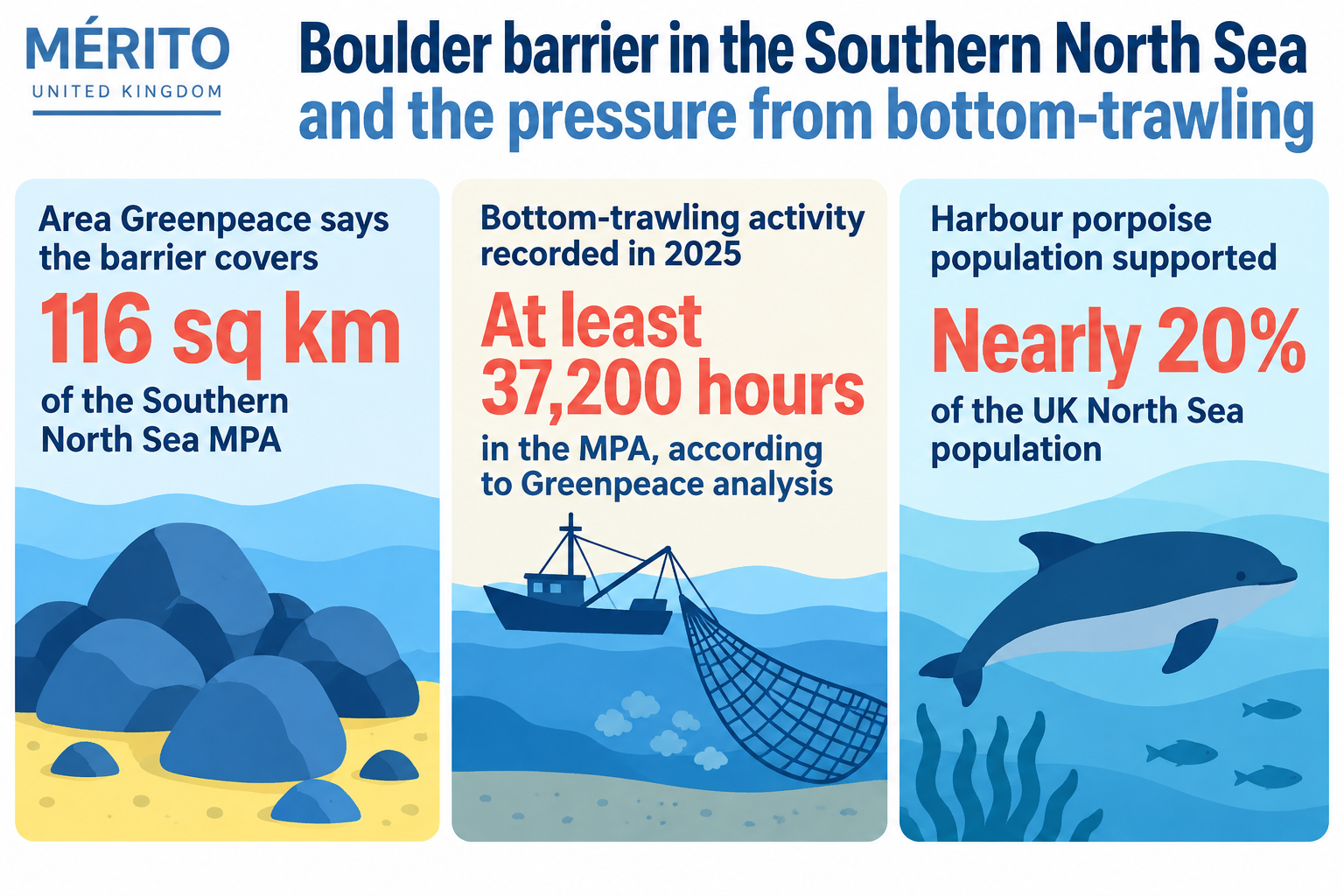
The group says its underwater barrier covers 116 sq km of an MPA designated to protect harbour porpoises, where its analysis recorded at least 37,200 hours of bottom trawling in 2025.
Greenpeace activists placed large boulders on the seabed in the Southern North Sea Marine Protected Area to obstruct bottom-trawling gear. The group says the barrier covers 116 sq km; its analysis recorded at least 37,200 hours of bottom trawling in the MPA in 2025. The action coincided with the BBC premiere of Blue Planet III.
The underwater barrier is intended to obstruct bottom-trawling gear in a marine protected area important to harbour porpoises.
Boulders laid on the seabed
Greenpeace activists placed boulders weighing up to two tonnes each on the seabed in the Southern North Sea Marine Protected Area, forming an underwater barrier intended to catch or obstruct bottom-trawling gear. The action took place off England’s east coast over the weekend, with the installation reported on 1 November 2026.
The group says the barrier effectively closes 116 sq km of the MPA to bottom trawling. That is Greenpeace’s estimate of the area obstructed by the boulders, not a legal fishing prohibition: the action does not itself change the rules governing fishing across the wider protected site. Greenpeace said its vessel, the Arctic Sunrise, would remain in the area to monitor and deter other forms of industrial fishing.
The site’s purpose and fishing activity
The Southern North Sea MPA was designated to protect harbour porpoises. The area supports nearly 20% of the UK North Sea harbour porpoise population, while fishing is not restricted across most of the MPA. The designation’s conservation purpose includes maintaining prey availability and preventing significant disturbance to the species.
Greenpeace’s analysis of fishing-activity data recorded at least 37,200 hours of bottom trawling in the MPA in 2025. The group describes it as the UK’s most heavily bottom-trawled offshore MPA. The figure is an estimate of fishing activity, not a count of boats or a measure of the proportion of the site trawled.
Campaign support and calls for action
Actors Simon Pegg and Benedict Cumberbatch signed boulders used in the action. Labour MP and former climate minister Kerry McCarthy also signed one. McCarthy called for a ban on bottom trawling and for properly protected ocean sanctuaries in UK waters and across the Atlantic.
Will McCallum, Greenpeace UK’s co-executive director, said the organisation had announced in June that it would take direct action if the government did not act to protect the seas. He said the group was challenging ministers to ban destructive fishing across protected waters and to support a network of ocean sanctuaries across the Atlantic. These are Greenpeace’s campaign demands; they do not describe a change to existing regulations.
The action coincided with the BBC premiere of the documentary series Blue Planet III. McCallum referred to the programme in describing the importance of the oceans and the threats they face.
Explore the background
Further reading
Selected background resources to explain the context and concepts behind this story.
Understand the specific conservation objectives and management advice for harbour porpoises within the Southern North Sea Marine Protected Area.
Southern North Sea Conservation Objectives and
The Southern North Sea Conservation Objectives and Advice PDF provides official guidance on protecting harbour porpoises, detailing habitat requirements, threat mitigation, and monitoring protocols relevant to the MPA.
Learn about EU regulations that prohibit bottom trawling and other static fishing gear within the Southern North Sea MPA.
Report and assessment of the status of the OSPAR network of ...
The OSPAR network assessment report outlines Council Regulation (EU) 2019/1241, which bans bottom trawling and similar gear in the MPA, offering legal context for Greenpeace’s action.
Explore best practices for designing resilient marine protected area networks, including considerations for species like harbour porpoises.
Marine Protected Area Networks
The CEC scientific guidelines document provides a framework for MPA network design, covering ecological connectivity and protection measures that inform effective management of the Southern North Sea area.
External links selected for their educational value. They are separate from the sources used to report this story.
Editorial transparency
Article integrity
These checks apply to the published version. Changes to its content or evidence require a fresh review.
Veracidad
Aprobado
Comprueba que la pieza tenga fuentes declaradas y verificadas, que el nivel de evidencia se presente correctamente y que el desarrollo sea suficiente para sostener sus afirmaciones.
100/100
Analizado 02/11/2026 14:39 · rules-v1
Ausencia de sesgo
Aprobado
Busca lenguaje emocional, descalificaciones, generalizaciones absolutas y una voz editorial impropia de una noticia. También comprueba atribuciones y pluralidad de fuentes cuando la materia es sensible.
100/100
Analizado 02/11/2026 14:39 · rules-v1
Ausencia de clickbait
Aprobado
Evalúa si el titular cuenta el hecho principal sin ocultarlo para provocar curiosidad, sin promesas exageradas y sin recursos tipográficos engañosos.
100/100
Analizado 02/11/2026 14:39 · rules-v1
Coherencia editorial
Aprobado
Contrasta titular, subtítulo, resumen y cuerpo para detectar contradicciones, cifras sin respaldo o un alcance mayor del que permite la información disponible.
100/100
Analizado 02/11/2026 14:39 · rules-v1
Plagio y originalidad
Aprobado
Compara la prosa con los extractos de las fuentes utilizadas y con hasta 250 publicaciones recientes de Mérito para detectar copia extensa o una reescritura demasiado cercana.
100/100
Analizado 02/11/2026 14:39 · rules-v1
Conflictos de interés
Aprobado
Analiza posibles relaciones entre la autoría, el medio y las fuentes, así como patrocinio, lenguaje promocional o dependencia exclusiva de comunicados de prensa.
100/100
Analizado 02/11/2026 14:39 · rules-v1
The score is a quality-control indicator, not a probability that something is true.