UK–EU summit talks include farm trade, emissions and youth mobility proposals
Officials have largely settled the outlines of three prospective deals, but the Brussels meeting on 20 November is still to come.
The UK and EU are due to meet in Brussels on 20 November 2026. Proposed arrangements include freer agricultural trade, emissions-scheme access and youth mobility. Government estimates put the potential economic contribution of the agricultural deal above £5bn, while Andy Burnham has cited a wider £17bn forecast; neither figure represents a realised gain.
The proposals remain prospective; the summit is scheduled for 20 November 2026.
The negotiations and proposed agricultural deal
The United Kingdom and European Union are scheduled to hold their summit in Brussels on 20 November 2026. The meeting is expected to cover a package of practical cooperation, rather than decide whether the UK will rejoin the EU.
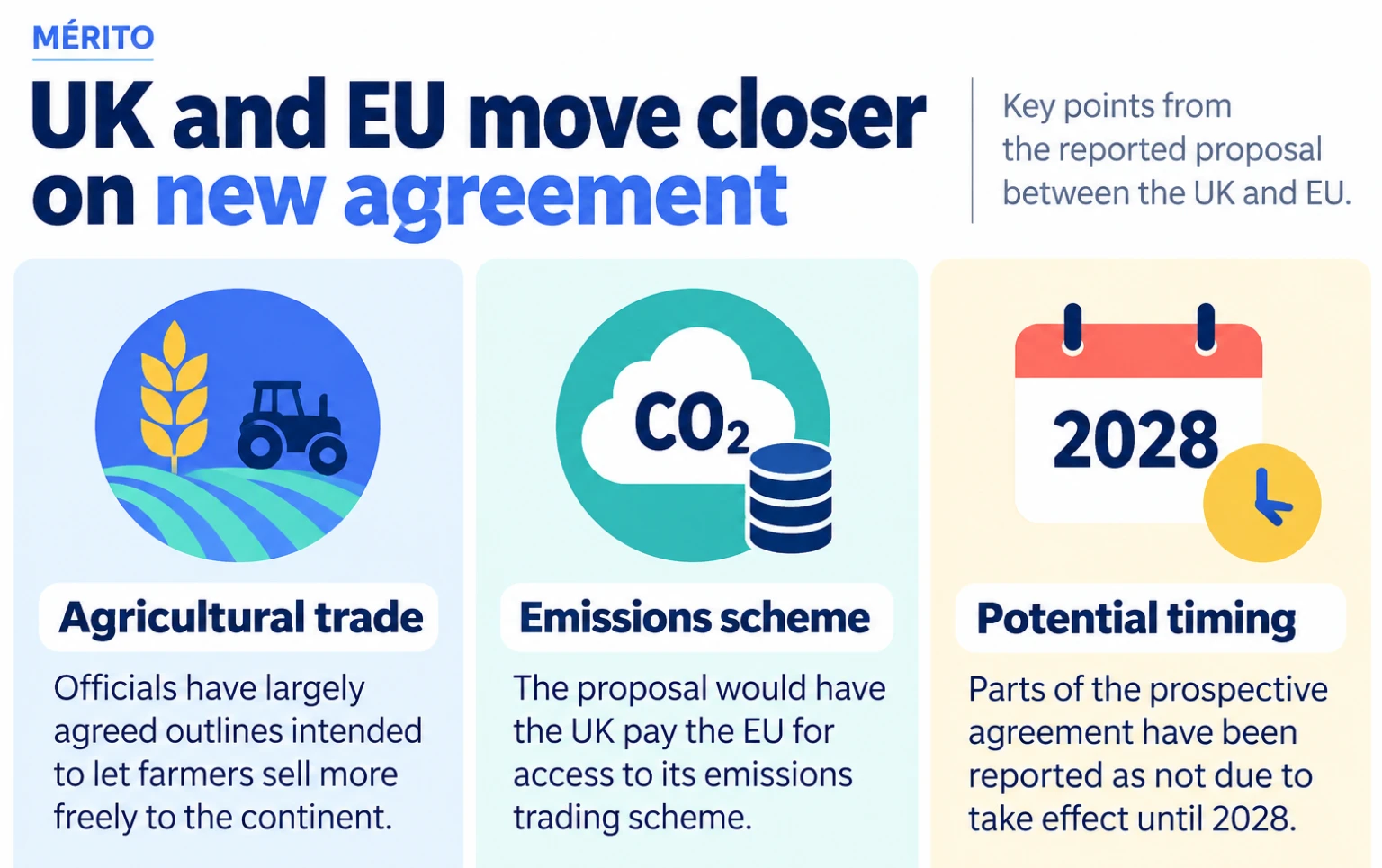
Officials have largely agreed the outlines of three prospective deals, including arrangements intended to let farmers sell more freely to the continent. The agricultural proposal is aimed at easing trade barriers on food and farming products. A draft agreement on removing checks on food and agricultural exports has been circulated to EU countries, but it is not yet an implemented deal.
The proposed package also includes easier arrangements for travelling with pets and a youth mobility scheme. The available material does not establish final terms for the youth proposal.
Timetable and economic estimates
Parts of the prospective agreement have been reported as not due to take effect until 2028. That is a timetable reported for elements of the proposed package, not confirmation that the summit has approved or brought them into force.
The government estimates that the agricultural agreement could be worth more than £5bn to the UK economy. A separate, broader estimate cited by Andy Burnham puts the potential boost from the overall agreement at £17bn, or 0.4% of GDP. These are forecasts attributed to the government and Burnham; they are not measured gains already delivered.
Emissions trading and the wider relationship
Under the proposed emissions arrangement, the UK would pay the EU for access to its emissions trading scheme. The proposal is intended to reduce friction in cross-border trade and address carbon-related charges, but its terms and effects remain prospective.
The package also includes closer cooperation on emissions trading and youth mobility. Andy Burnham has argued that reducing administrative barriers on food trade could help households and producers, but any effect on prices remains a claim about a possible future outcome. The summit is a step in the wider relationship; it is not a decision on EU membership.
Explore the background
Further reading
Selected background resources to explain the context and concepts behind this story.
Understand the regulatory framework and operational mechanics of the UK Emissions Trading Scheme (UK ETS).
UK Emissions Trading Scheme
The article mentions the UK paying for access to the EU's emissions scheme; this NAO report provides the official documentation on how the UK's own scheme functions, offering a necessary baseline for comparing the two systems.
Youth mobility is a key proposal in the summit talks; this gov.uk guidance defines the current rules, age limits, and duration of the scheme, allowing readers to assess what changes might be proposed.
Analyze the current state of UK agricultural trade and food security dependencies.
UK Food Security Report 2024
The article cites a £5bn potential gain from agricultural trade; this official report provides the underlying data on production, trade shares, and security risks, contextualizing the economic estimates.
Compare the UK ETS with other global emissions trading systems to understand international standards.
EMISSIONS TRADING WORLDWIDE
The proposal involves cross-border emissions trading; this ICAP report offers a comparative overview of how different economies structure their carbon markets, providing a broader perspective on the technical challenges of linking schemes.
External links selected for their educational value. They are separate from the sources used to report this story.
Editorial transparency
Article integrity
These checks apply to the published version. Changes to its content or evidence require a fresh review.
Veracidad
Aprobado
Comprueba que la pieza tenga fuentes declaradas y verificadas, que el nivel de evidencia se presente correctamente y que el desarrollo sea suficiente para sostener sus afirmaciones.
100/100
Analizado 08/11/2026 04:39 · rules-v1
Ausencia de sesgo
Aprobado
Busca lenguaje emocional, descalificaciones, generalizaciones absolutas y una voz editorial impropia de una noticia. También comprueba atribuciones y pluralidad de fuentes cuando la materia es sensible.
100/100
Analizado 08/11/2026 04:39 · rules-v1
Ausencia de clickbait
Aprobado
Evalúa si el titular cuenta el hecho principal sin ocultarlo para provocar curiosidad, sin promesas exageradas y sin recursos tipográficos engañosos.
100/100
Analizado 08/11/2026 04:39 · rules-v1
Coherencia editorial
Aprobado
Contrasta titular, subtítulo, resumen y cuerpo para detectar contradicciones, cifras sin respaldo o un alcance mayor del que permite la información disponible.
100/100
Analizado 08/11/2026 04:39 · rules-v1
Plagio y originalidad
Aprobado
Compara la prosa con los extractos de las fuentes utilizadas y con hasta 250 publicaciones recientes de Mérito para detectar copia extensa o una reescritura demasiado cercana.
100/100
Analizado 08/11/2026 04:39 · rules-v1
Conflictos de interés
Aprobado
Analiza posibles relaciones entre la autoría, el medio y las fuentes, así como patrocinio, lenguaje promocional o dependencia exclusiva de comunicados de prensa.
100/100
Analizado 08/11/2026 04:39 · rules-v1
The score is a quality-control indicator, not a probability that something is true.