Government sets out business red-tape plan with almost £800m in projected annual savings
The package includes changes to company reporting, asset-manager requirements and import tariffs, alongside measures aimed at smaller firms.
The government says its announced measures could save businesses almost £800 million a year in administrative and tariff costs. The package includes reporting reforms, extended tariff suspensions and changes intended to reduce paperwork for smaller firms.
The figures are government estimates and targets for the announced measures.
A package of reporting and tariff measures
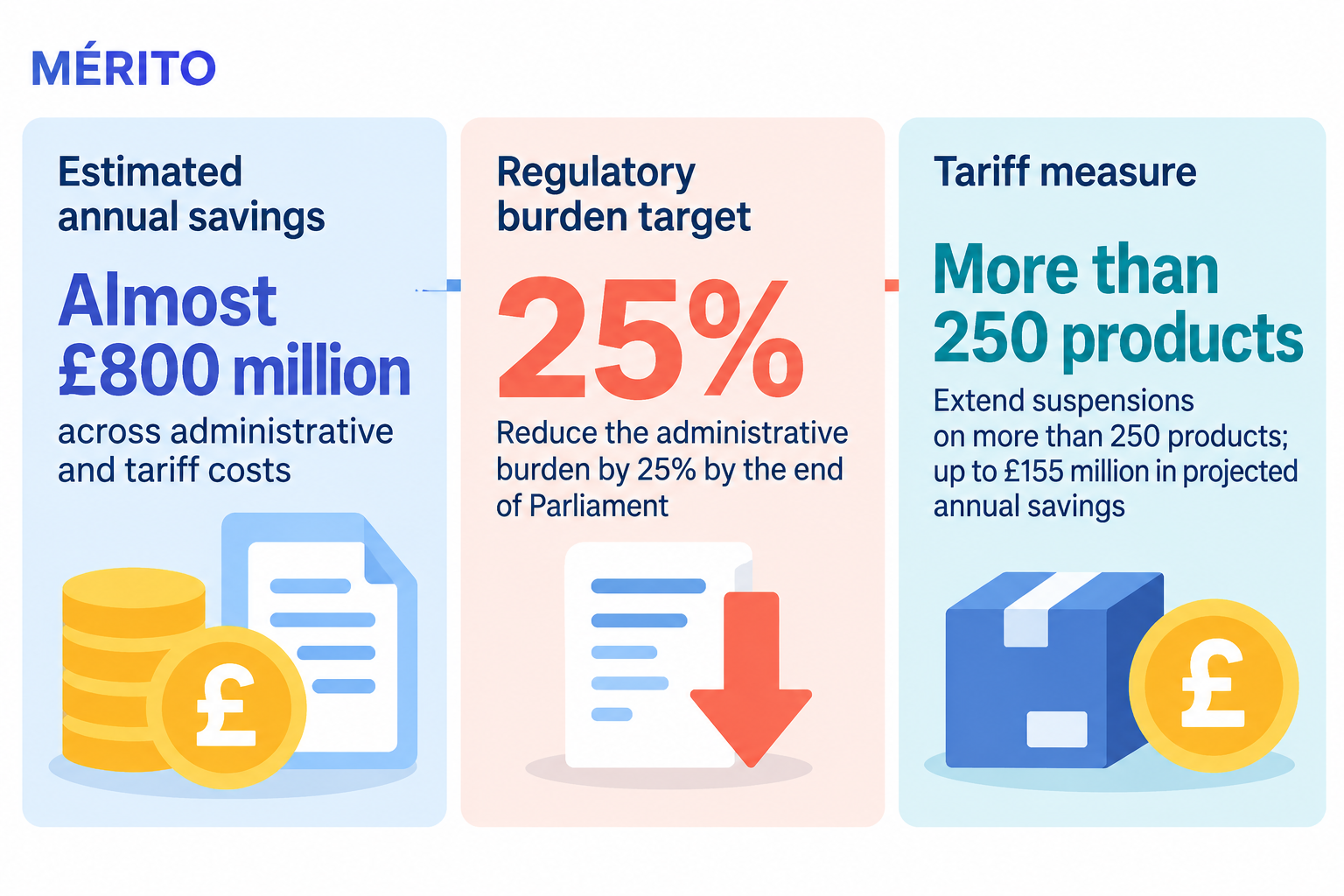
The government has announced measures it says could save businesses almost £800 million a year in administrative and tariff costs. The package is intended to reduce paperwork and duplicate information requests; the estimate describes projected savings, not savings already realised.
The announced reporting changes are expected to save firms up to £290 million a year through streamlined company reporting requirements. Changes to reporting burdens for asset managers are estimated to save £105 million a year, while streamlining the home-buying and selling process is expected to save businesses in the transaction chain £116 million a year.
The government is also extending import tariff suspensions on more than 250 products favoured by businesses. It estimates that this measure could save up to £155 million a year. The package contributes to a stated target of cutting the administrative burden of regulation on businesses by 25% by the end of Parliament.
Measures aimed at smaller firms
The announced measures also include making compliance guidance clearer and easier for small businesses, simplifying how firms access government support, and giving smaller businesses a way to report regulations they consider disproportionate.
The government says it will simplify bidding for public contracts by standardising requirements in areas such as construction and streamline business surveys to reduce the number of data requests. It also says it will pause the planned Companies House profit-and-loss filing requirement for the smallest businesses, which had been scheduled for April 2028.
The measures follow work by the Small Business Taskforce, whose recommendations were developed with business representatives. The Federation of Small Businesses said the taskforce’s recommendations were intended to reduce compliance burdens and welcomed the pause to the filing requirement for the smallest businesses.
Explore the background
Further reading
Selected background resources to explain the context and concepts behind this story.
Understand the legal framework and operational details of tariff suspensions that apply to UK imports, including eligibility criteria and administrative procedures.
Autonomous tariff suspensions and quotas
The EU Customs website provides authoritative information on autonomous tariff suspensions and quotas, explaining how these measures reduce costs for businesses importing goods.
Learn the key terms used in UK business regulation, especially those related to reporting obligations and regulatory compliance.
Glossary of terms
The FCA glossary offers clear definitions of statutory concepts such as ‘conduct of business’ and ‘authorised firm’, which are central to understanding the government's cost‑saving measures.
Explore evidence-based approaches to reducing regulatory burden on businesses, including case studies and policy recommendations.
Less is More: Reducing Burdens, Improving Outcomes
The ‘Less is More’ report from the Business Regulation Team provides an analysis of how simplifying regulations can improve outcomes for firms, directly relating to the government's 25% reduction target.
External links selected for their educational value. They are separate from the sources used to report this story.
Editorial transparency
Article integrity
These checks apply to the published version. Changes to its content or evidence require a fresh review.
Veracidad
Aprobado
Comprueba que la pieza tenga fuentes declaradas y verificadas, que el nivel de evidencia se presente correctamente y que el desarrollo sea suficiente para sostener sus afirmaciones.
100/100
Analizado 23/10/2026 08:31 · rules-v1
Ausencia de sesgo
Aprobado
Busca lenguaje emocional, descalificaciones, generalizaciones absolutas y una voz editorial impropia de una noticia. También comprueba atribuciones y pluralidad de fuentes cuando la materia es sensible.
100/100
Analizado 23/10/2026 08:31 · rules-v1
Ausencia de clickbait
Aprobado
Evalúa si el titular cuenta el hecho principal sin ocultarlo para provocar curiosidad, sin promesas exageradas y sin recursos tipográficos engañosos.
100/100
Analizado 23/10/2026 08:31 · rules-v1
Coherencia editorial
Aprobado
Contrasta titular, subtítulo, resumen y cuerpo para detectar contradicciones, cifras sin respaldo o un alcance mayor del que permite la información disponible.
100/100
Analizado 23/10/2026 08:31 · rules-v1
Plagio y originalidad
Aprobado
Compara la prosa con los extractos de las fuentes utilizadas y con hasta 250 publicaciones recientes de Mérito para detectar copia extensa o una reescritura demasiado cercana.
100/100
Analizado 23/10/2026 08:31 · rules-v1
Conflictos de interés
Aprobado
Analiza posibles relaciones entre la autoría, el medio y las fuentes, así como patrocinio, lenguaje promocional o dependencia exclusiva de comunicados de prensa.
100/100
Analizado 23/10/2026 08:31 · rules-v1
The score is a quality-control indicator, not a probability that something is true.