Burnham backs Ukraine and calls for a ‘win-win’ UK–EU deal
At the 12 November European Political Community summit in Dublin, he voiced support for Volodymyr Zelensky and discussed a prospective reset with Ursula von der Leyen.
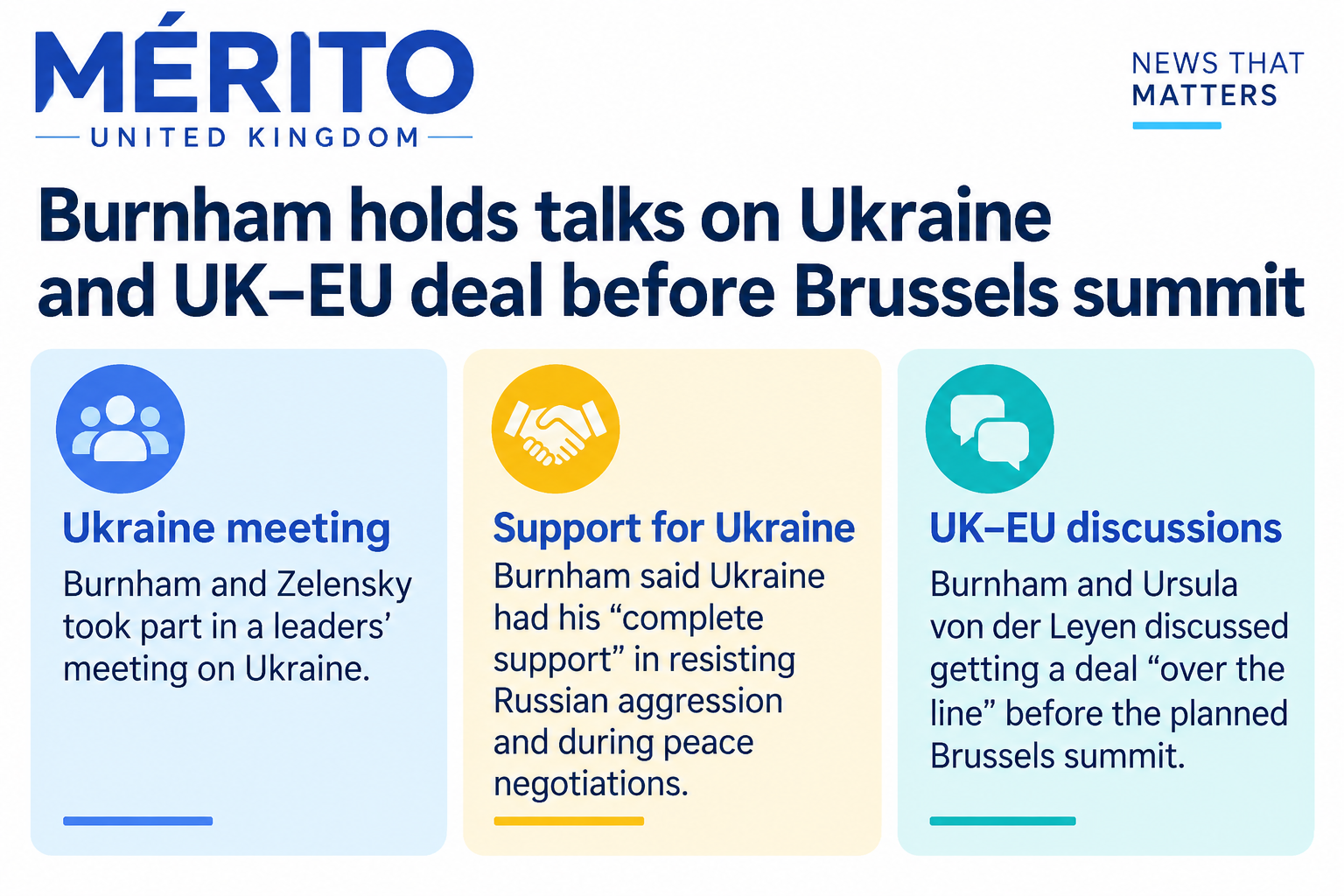
Andy Burnham took part in a meeting on Ukraine with Volodymyr Zelensky at the European Political Community summit in Dublin on 12 November 2026, saying Ukraine had his “complete support” in resisting Russian aggression and during peace negotiations. He also discussed the planned UK–EU summit in Brussels, saying a deal could benefit both sides, while criticising David Cameron’s claim that Britain’s low growth had “nothing to do with Brexit”.
Burnham’s Ukraine and UK–EU discussions took place at the European Political Community summit in Dublin on 12 November 2026.
Support for Ukraine at the Dublin summit
At the European Political Community summit in Dublin on 12 November 2026, Prime Minister Andy Burnham and Ukrainian President Volodymyr Zelensky took part in a meeting on Ukraine with other leaders. Burnham co-chaired the discussion, where the leaders considered support for Ukraine and its place in peace negotiations.
Burnham told Zelensky that Ukraine had his “complete support” both in resisting Russian aggression and in the negotiations. He said allies would support Ukraine through the process and continue to press for European representation in the talks.
More than a dozen leaders attended the meeting, including Emmanuel Macron, Friedrich Merz, Micheál Martin and Mark Carney. The summit brought together leaders from around 50 countries.
Prospective UK–EU agreements
Burnham also used the summit to discuss the UK’s relationship with the European Union ahead of a planned UK–EU summit in Brussels the following week. In a bilateral meeting with European Commission president Ursula von der Leyen, he said they would work to get a deal “over the line” before the summit.
The proposed package included areas such as food and farming, emissions trading and a youth mobility scheme. These were prospective agreements: Burnham said the deal was not complete and that negotiations still had a long way to go.
Burnham described a possible agreement as a “win-win for Britain and Europe” and said it could be more like the Brexit people thought they were voting for in 2016. He said the talks were about closer working relations and that “no one’s talking about rejoin”.
Burnham’s response to David Cameron
Asked about David Cameron’s argument that Britain’s economic problems had nothing to do with leaving the EU, Burnham said Cameron was wrong to dismiss a connection between Brexit and the UK’s low growth over the previous decade. He said “the evidence says otherwise” and referred to Treasury analysis.
Burnham also characterised Cameron’s intervention as more concerned with unity in the Conservative Party than with British interests. The disagreement arose as Burnham made the case for negotiating closer UK–EU ties, while maintaining that the talks were not about rejoining the bloc.
Explore the background
Further reading
Selected background resources to explain the context and concepts behind this story.
Understand Volodymyr Zelensky’s formal roles in Ukraine’s government and armed forces.
Supreme Commander of the Armed Forces of Ukraine | Ministry ...
The Ukrainian Ministry of Defence identifies him as both president and commander-in-chief, clarifying the offices relevant to his participation in the Ukraine discussion.
Learn about Ursula von der Leyen’s public-service background and European Commission position.
Ursula von der Leyen - Enlargement and Eastern Neighbourhood
The Commission’s profile offers a brief introduction to the person involved in the reported UK–EU discussions; it complements the article without recounting the meeting.
External links selected for their educational value. They are separate from the sources used to report this story.
Editorial transparency
Article integrity
These checks apply to the published version. Changes to its content or evidence require a fresh review.
Veracidad
Aprobado
Comprueba que la pieza tenga fuentes declaradas y verificadas, que el nivel de evidencia se presente correctamente y que el desarrollo sea suficiente para sostener sus afirmaciones.
100/100
Analizado 13/11/2026 04:34 · rules-v1
Ausencia de sesgo
Aprobado
Busca lenguaje emocional, descalificaciones, generalizaciones absolutas y una voz editorial impropia de una noticia. También comprueba atribuciones y pluralidad de fuentes cuando la materia es sensible.
100/100
Analizado 13/11/2026 04:34 · rules-v1
Ausencia de clickbait
Aprobado
Evalúa si el titular cuenta el hecho principal sin ocultarlo para provocar curiosidad, sin promesas exageradas y sin recursos tipográficos engañosos.
100/100
Analizado 13/11/2026 04:34 · rules-v1
Coherencia editorial
Aprobado
Contrasta titular, subtítulo, resumen y cuerpo para detectar contradicciones, cifras sin respaldo o un alcance mayor del que permite la información disponible.
100/100
Analizado 13/11/2026 04:34 · rules-v1
Plagio y originalidad
Aprobado
Compara la prosa con los extractos de las fuentes utilizadas y con hasta 250 publicaciones recientes de Mérito para detectar copia extensa o una reescritura demasiado cercana.
100/100
Analizado 13/11/2026 04:34 · rules-v1
Conflictos de interés
Aprobado
Analiza posibles relaciones entre la autoría, el medio y las fuentes, así como patrocinio, lenguaje promocional o dependencia exclusiva de comunicados de prensa.
100/100
Analizado 13/11/2026 04:34 · rules-v1
The score is a quality-control indicator, not a probability that something is true.