Burnham rejects claim slavery apology talks complicated King’s role
After meeting Charles in Antigua, the Prime Minister said he was “reaching out and listening”; Buckingham Palace described the monarch’s role in the Commonwealth as non-political.
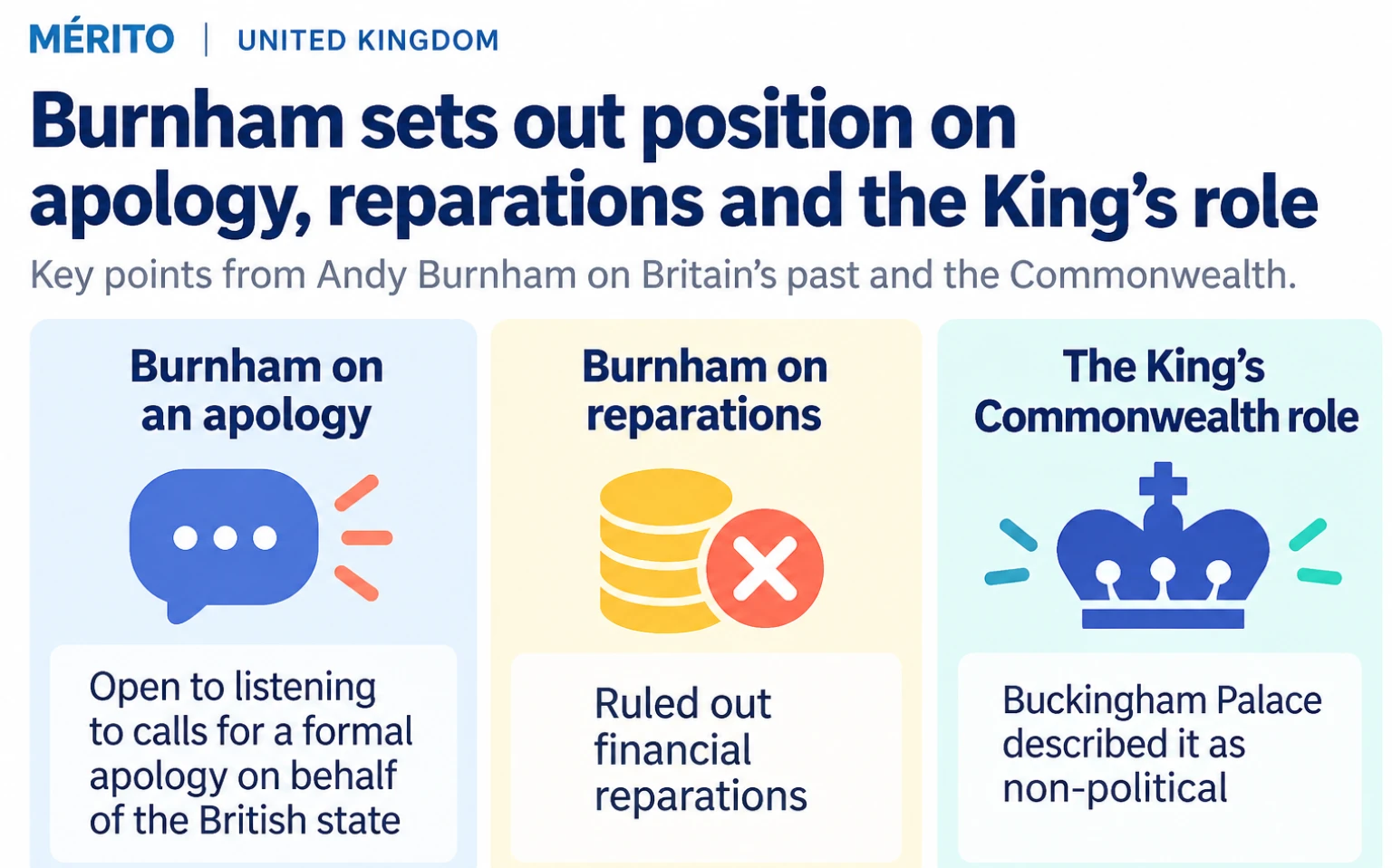
Andy Burnham met King Charles at a Commonwealth Business Forum in Antigua and denied that his openness to hearing calls for a formal slavery apology had made matters more difficult for the monarch. Burnham has ruled out financial reparations. Buckingham Palace has said the King’s role in the Commonwealth is non-political and focused on bringing people together.
Burnham met King Charles in Antigua amid debate about historical responsibility and the Commonwealth.
Burnham defends his approach after meeting the King
Prime Minister Andy Burnham rejected the suggestion that his offer to hear calls for a formal apology over slavery had made matters more difficult for King Charles. The two met in Antigua at a Commonwealth Business Forum, their first meeting since Burnham set out his position on the issue.
Asked whether he had made things more difficult for the King, Burnham replied: “No. We are reaching out and listening.” He said his aim was to listen, bring a new approach to the Commonwealth and bring people together.
Burnham has said he is open to listening to calls for a formal apology on behalf of the British state, while ruling out financial reparations. His position is an offer of dialogue and consideration of calls for an apology, not an announcement that an apology or reparations will be made.
The Palace’s description of the King’s role
Buckingham Palace has described King Charles’s role in the Commonwealth as non-political. It said he helps bring people together from public and private sectors across the 56-nation organisation, and connects leaders, institutions and investors around shared interests.
The Palace’s account distinguishes the monarch’s role from government policy. Separately, Downing Street has said strengthening the Commonwealth is in the UK’s interest amid efforts by China and Russia to exert influence.
A debate continuing around the Commonwealth meeting
The meeting in Antigua took place ahead of the Commonwealth Heads of Government Meeting. Caribbean reparations campaigners called for an apology and reparatory justice, while Burnham’s stated position was to offer structured dialogue and reject financial reparations.
Burnham did not answer a question about whether the King should personally apologise on behalf of his ancestors. That is distinct from Burnham’s offer to listen to calls for a formal apology by the British state and from the government’s position against financial reparations.
Burnham has argued that people living today should not be held liable for historical wrongs in which they had no personal part. He has proposed structured dialogue with those affected by the transatlantic slave trade.
Explore the background
Further reading
Selected background resources to explain the context and concepts behind this story.
Understand the legal distinction between the abolition of the transatlantic slave trade and the abolition of slavery itself in British history.
Slavery and the Slave Trade - National ...
This National Records of Scotland guide clarifies the specific legislative milestones, such as the Act of 1807, which is essential context for understanding the historical timeline that underpins current debates on apologies and reparations.
Examine the historical financial relationship between the Bank of England and the slave trade, including the compensation paid to slave owners.
Slavery & the Bank: Large print guide
The Bank of England's museum guide provides concrete historical data on how state institutions were involved in the slave economy, offering a factual basis for understanding the complexity of the reparations debate mentioned in the article.
Access primary source materials and digital collections related to the history of British slavery.
Digital Collections - History of British Slavery
The Library of Congress guide offers a curated list of books and printed materials, allowing readers to explore the primary evidence and scholarly works that inform the historical narrative of the transatlantic slave trade.
Define the term 'reparations' within the context of international law and asset recovery.
Glossary of Asset Recovery Terms
The World Bank glossary provides a precise, neutral definition of reparations as voluntary payments by a wrongdoer, helping readers distinguish between legal concepts and political rhetoric used in the article.
External links selected for their educational value. They are separate from the sources used to report this story.
Editorial transparency
Article integrity
These checks apply to the published version. Changes to its content or evidence require a fresh review.
Veracidad
Aprobado
Comprueba que la pieza tenga fuentes declaradas y verificadas, que el nivel de evidencia se presente correctamente y que el desarrollo sea suficiente para sostener sus afirmaciones.
100/100
Analizado 03/11/2026 05:35 · rules-v1
Ausencia de sesgo
Aprobado
Busca lenguaje emocional, descalificaciones, generalizaciones absolutas y una voz editorial impropia de una noticia. También comprueba atribuciones y pluralidad de fuentes cuando la materia es sensible.
100/100
Analizado 03/11/2026 05:35 · rules-v1
Ausencia de clickbait
Aprobado
Evalúa si el titular cuenta el hecho principal sin ocultarlo para provocar curiosidad, sin promesas exageradas y sin recursos tipográficos engañosos.
100/100
Analizado 03/11/2026 05:35 · rules-v1
Coherencia editorial
Aprobado
Contrasta titular, subtítulo, resumen y cuerpo para detectar contradicciones, cifras sin respaldo o un alcance mayor del que permite la información disponible.
100/100
Analizado 03/11/2026 05:35 · rules-v1
Plagio y originalidad
Aprobado
Compara la prosa con los extractos de las fuentes utilizadas y con hasta 250 publicaciones recientes de Mérito para detectar copia extensa o una reescritura demasiado cercana.
100/100
Analizado 03/11/2026 05:35 · rules-v1
Conflictos de interés
Aprobado
Analiza posibles relaciones entre la autoría, el medio y las fuentes, así como patrocinio, lenguaje promocional o dependencia exclusiva de comunicados de prensa.
100/100
Analizado 03/11/2026 05:35 · rules-v1
The score is a quality-control indicator, not a probability that something is true.