King expresses sorrow over slave trade but makes no formal apology
Charles spoke at the Commonwealth meeting in Antigua and Barbuda during a nine-day Caribbean tour that also included the Bahamas and Guyana.
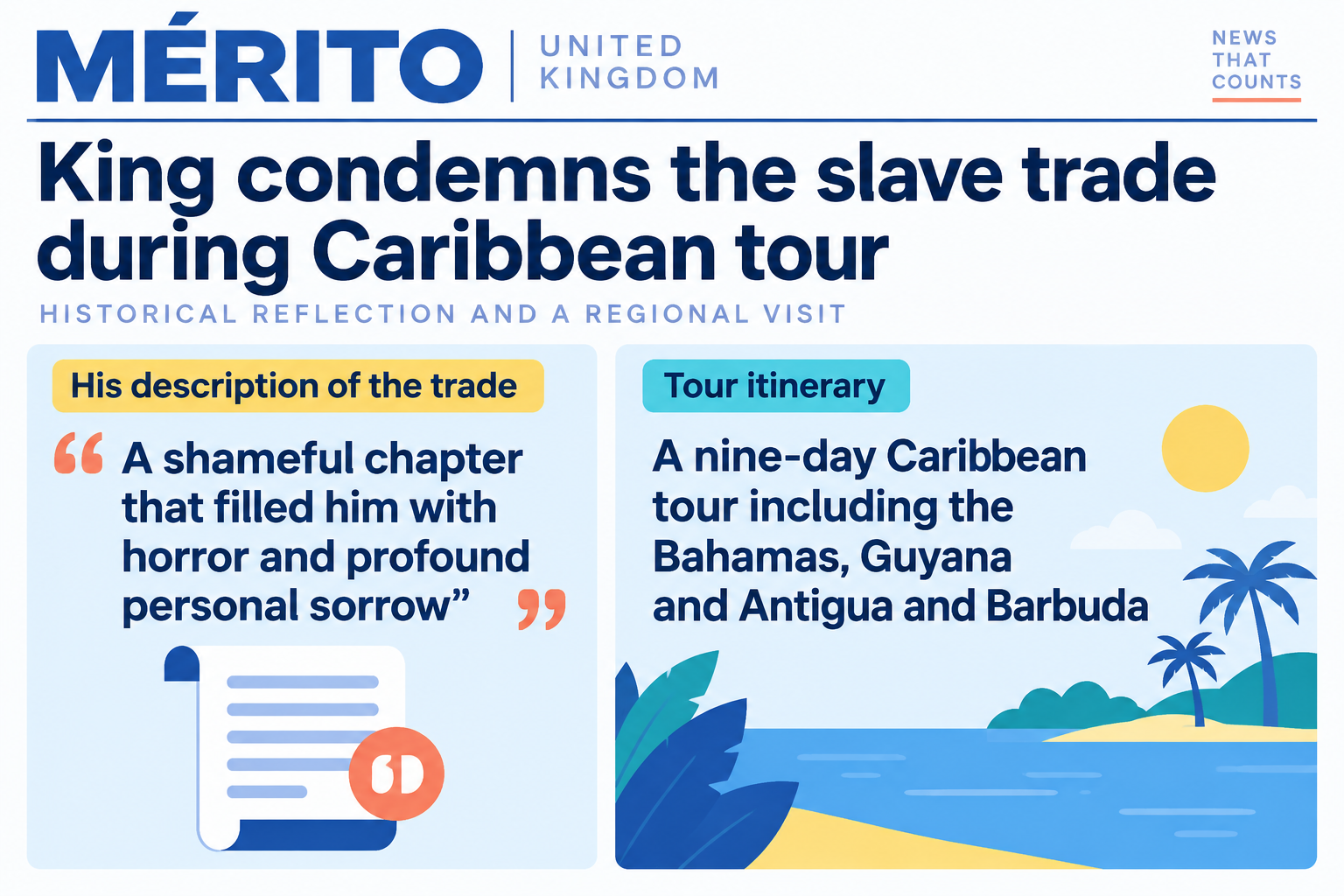
At the Commonwealth Heads of Government Meeting in Antigua and Barbuda, King Charles described the transatlantic slave trade as a shameful chapter that filled him with horror and profound sorrow. He did not make a formal apology, instead calling for learning from history and practical cooperation for the future. The address came during a nine-day Caribbean tour that included the Bahamas, Guyana and Antigua and Barbuda.
Charles spoke at the Commonwealth meeting in Antigua and Barbuda during a nine-day tour of the Caribbean.
A statement of sorrow, not an apology
King Charles addressed leaders of the Commonwealth’s 56 member states at the opening ceremony of the Commonwealth Heads of Government Meeting in Antigua and Barbuda. He described the transatlantic trade in enslaved people as a “shameful chapter” that filled his heart with horror and his soul with profound personal sorrow.
The speech stopped short of a formal apology. Charles said history could teach present generations and that its consequences continued to affect Caribbean islands and other Commonwealth members. He also referred to the Royal Navy’s role in ending the international trade, without making an apology on behalf of the British state or the monarchy.
The speech during a nine-day Caribbean tour
The address took place during Charles’s nine-day tour of the Caribbean, which included visits to the Bahamas and Guyana before Antigua and Barbuda. His speech at the Commonwealth meeting came during the Antigua and Barbuda leg of the tour.
During the address, Charles said he had become more committed to working in modern partnership to address past wrongs through action for the future. He named access to education, jobs and opportunities, intra-Commonwealth trade and climate resilience as areas where cooperation could help people facing hardship and disadvantage.
The UK Government’s position on apology talks
Calls for a formal apology and reparatory justice formed part of the debate around the meeting. Before the summit, UK Prime Minister Andy Burnham said he was open to dialogue about a formal apology but ruled out financial reparations.
That was the Government’s position, not an apology by the King or a commitment to compensation. Charles’s speech called for learning from history and future cooperation; it did not announce a formal apology or a reparations policy.
Explore the background
Further reading
Selected background resources to explain the context and concepts behind this story.
Identify primary archival sources for studying the 18th and 19th-century transatlantic slave trade.
Infosheet No - Maritime Archives
This maritime archives guide provides a structured list of documentary evidence, helping readers understand the historical record behind the King's remarks on the slave trade.
Understand the legal and institutional framework of Antigua and Barbuda within the Commonwealth.
Antigua and Barbuda | IALS Digital resources
As a digital resource from the University of Oxford, this page offers stable reference material on the country's legal profile and its relationship with Commonwealth institutions.
Explain the constitutional structure of Antigua and Barbuda as a Commonwealth realm.
Antigua and Barbuda: Government - globalEDGE
This educational profile from Michigan State University clarifies the role of the monarch and the prime minister, providing context for the King's diplomatic visit.
Analyze the formal arguments for reparations presented by Caribbean nations.
A MANIFESTO FOR THE COMING ENLIGHTENMENT
This manifesto from CARICOM outlines the region's official stance on slavery and reparations, offering a direct counterpoint to the King's decision not to issue a formal apology.
External links selected for their educational value. They are separate from the sources used to report this story.
Editorial transparency
Article integrity
These checks apply to the published version. Changes to its content or evidence require a fresh review.
Veracidad
Aprobado
Comprueba que la pieza tenga fuentes declaradas y verificadas, que el nivel de evidencia se presente correctamente y que el desarrollo sea suficiente para sostener sus afirmaciones.
100/100
Analizado 03/11/2026 23:33 · rules-v1
Ausencia de sesgo
Aprobado
Busca lenguaje emocional, descalificaciones, generalizaciones absolutas y una voz editorial impropia de una noticia. También comprueba atribuciones y pluralidad de fuentes cuando la materia es sensible.
100/100
Analizado 03/11/2026 23:33 · rules-v1
Ausencia de clickbait
Aprobado
Evalúa si el titular cuenta el hecho principal sin ocultarlo para provocar curiosidad, sin promesas exageradas y sin recursos tipográficos engañosos.
100/100
Analizado 03/11/2026 23:33 · rules-v1
Coherencia editorial
Aprobado
Contrasta titular, subtítulo, resumen y cuerpo para detectar contradicciones, cifras sin respaldo o un alcance mayor del que permite la información disponible.
100/100
Analizado 03/11/2026 23:33 · rules-v1
Plagio y originalidad
Aprobado
Compara la prosa con los extractos de las fuentes utilizadas y con hasta 250 publicaciones recientes de Mérito para detectar copia extensa o una reescritura demasiado cercana.
100/100
Analizado 03/11/2026 23:33 · rules-v1
Conflictos de interés
Aprobado
Analiza posibles relaciones entre la autoría, el medio y las fuentes, así como patrocinio, lenguaje promocional o dependencia exclusiva de comunicados de prensa.
100/100
Analizado 03/11/2026 23:33 · rules-v1
The score is a quality-control indicator, not a probability that something is true.