Judge dismisses Trump’s defamation lawsuit over Epstein letter report
The Florida court ruled the amended complaint did not plausibly plead actual malice, and said a public figure’s denial alone cannot prevent publication.
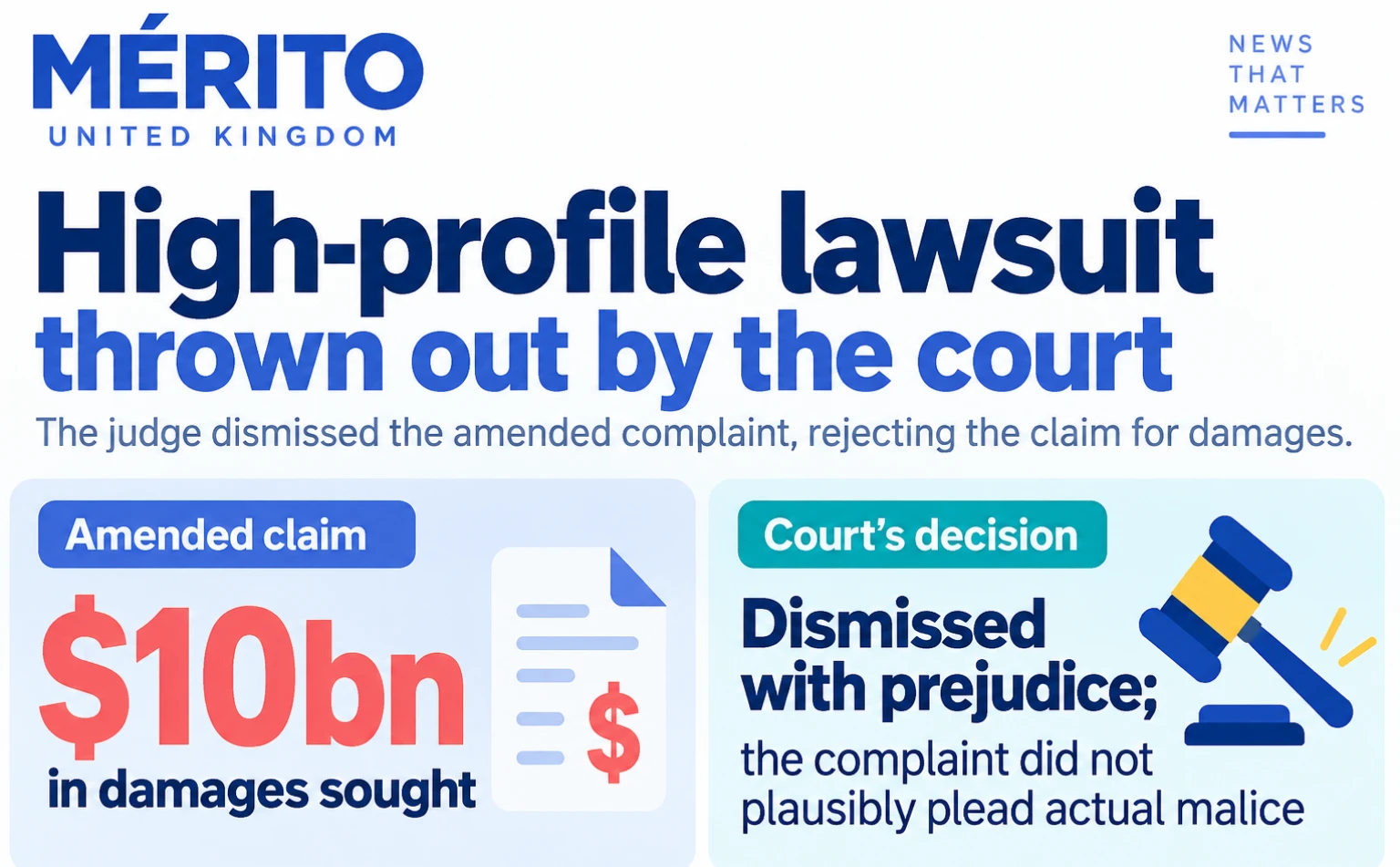
A federal judge dismissed Donald Trump’s defamation lawsuit against The Wall Street Journal, its parent company and other defendants. The amended complaint sought $10bn in damages and concerned reporting about an alleged letter to Jeffrey Epstein, which Trump denied writing or signing.
Judge Darrin Gayles dismissed the amended complaint after finding it did not meet the actual-malice pleading standard.
Why the case was dismissed
US District Judge Darrin Gayles dismissed Donald Trump’s defamation lawsuit against The Wall Street Journal, its parent company and other defendants with prejudice. The case arose from reporting about an alleged 2003 letter to Jeffrey Epstein; Trump denied writing or signing it.
The amended complaint sought $10bn in damages. Trump had initially sought $20bn before his team refiled the suit seeking $10bn.
The judge found that the amended complaint did not plausibly allege actual malice—that the defendants knew a statement was false or acted with reckless disregard for its truth. Public figures must meet this standard to pursue defamation claims in the United States.
The judge also rejected the argument that Trump’s denial should have stopped publication. Gayles wrote that if a public figure’s denial alone barred reporting, journalists would be prevented from publishing negative or contradictory material, a result that would run afoul of the First Amendment.
The dismissal followed an earlier ruling that had allowed Trump to amend his complaint. The amended complaint still did not meet the required legal threshold.
Explore the background
Further reading
Selected background resources to explain the context and concepts behind this story.
Define the legal standard of 'actual malice' and distinguish it from general negligence in defamation cases.
Glossary - Legal Resources & Know-How for Professionals
The article mentions that the judge's decision relied on the First Amendment and the status of the plaintiff as a public figure. This glossary provides a stable, professional definition of 'actual malice,' a key legal concept required for public figures to win defamation suits, helping readers understand the high bar set by the court.
Examine the historical legislative framework for libel and defamation in the United Kingdom.
Libel Act 1843
As a UK-based edition, providing the text of the Libel Act 1843 offers a comparative legal perspective. It allows readers to understand the statutory origins of defamation law and how concepts like 'malice' have been codified in legislation, contrasting with the US constitutional approach mentioned in the news.
This terminology guide explicitly explains that public figures must prove 'actual malice' to win a suit. It serves as an accessible educational resource that clarifies why a public figure's denial alone is often insufficient to stop reporting, directly supporting the judge's reasoning in the article.
External links selected for their educational value. They are separate from the sources used to report this story.
Editorial transparency
Article integrity
These checks apply to the published version. Changes to its content or evidence require a fresh review.
Veracidad
Aprobado
Comprueba que la pieza tenga fuentes declaradas y verificadas, que el nivel de evidencia se presente correctamente y que el desarrollo sea suficiente para sostener sus afirmaciones.
100/100
Analizado 01/11/2026 05:31 · rules-v1
Ausencia de sesgo
Aprobado
Busca lenguaje emocional, descalificaciones, generalizaciones absolutas y una voz editorial impropia de una noticia. También comprueba atribuciones y pluralidad de fuentes cuando la materia es sensible.
100/100
Analizado 01/11/2026 05:31 · rules-v1
Ausencia de clickbait
Aprobado
Evalúa si el titular cuenta el hecho principal sin ocultarlo para provocar curiosidad, sin promesas exageradas y sin recursos tipográficos engañosos.
100/100
Analizado 01/11/2026 05:31 · rules-v1
Coherencia editorial
Aprobado
Contrasta titular, subtítulo, resumen y cuerpo para detectar contradicciones, cifras sin respaldo o un alcance mayor del que permite la información disponible.
100/100
Analizado 01/11/2026 05:31 · rules-v1
Plagio y originalidad
Aprobado
Compara la prosa con los extractos de las fuentes utilizadas y con hasta 250 publicaciones recientes de Mérito para detectar copia extensa o una reescritura demasiado cercana.
100/100
Analizado 01/11/2026 05:31 · rules-v1
Conflictos de interés
Aprobado
Analiza posibles relaciones entre la autoría, el medio y las fuentes, así como patrocinio, lenguaje promocional o dependencia exclusiva de comunicados de prensa.
100/100
Analizado 01/11/2026 05:31 · rules-v1
The score is a quality-control indicator, not a probability that something is true.