
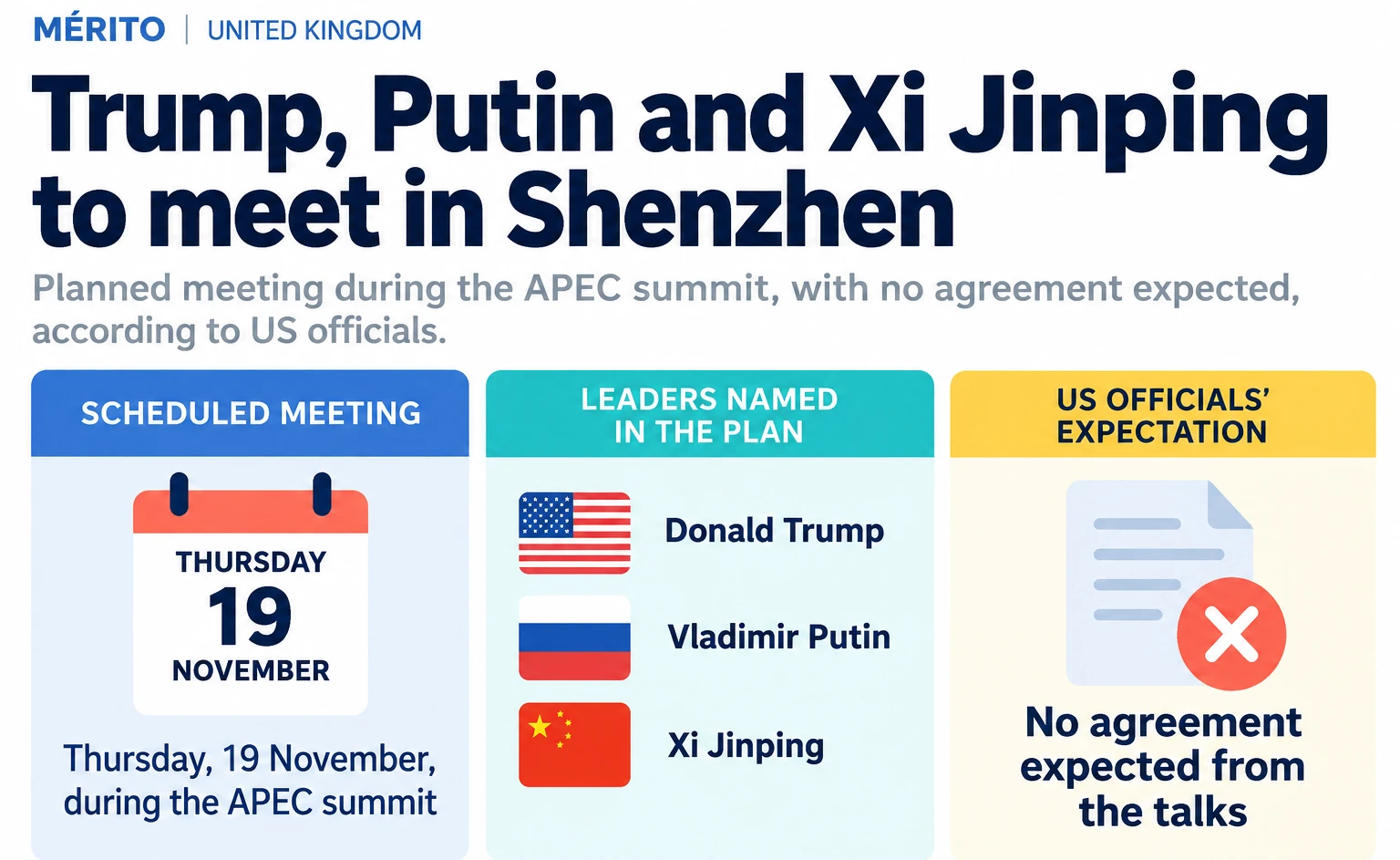
Meeting planned alongside the APEC summit
The White House has announced that Donald Trump, Vladimir Putin and Xi Jinping are scheduled to meet in Shenzhen on Thursday, 19 November, alongside the Asia-Pacific Economic Cooperation summit. The summit runs from 18 to 19 November, bringing the planned leaders’ meeting into its final day.
Trump’s Asia-Pacific itinerary is expected to begin with an Association of Southeast Asian Nations summit in the Philippines on Tuesday, before he travels to Shenzhen. He is also scheduled to hold bilateral talks with Xi on Thursday. Reports describe those talks as the pair’s fourth face-to-face meeting since Trump returned to the White House in 2025.
The trilateral gathering would bring the leaders of the United States, Russia and China together in a format distinct from their bilateral meetings. Reports available at the time said Beijing and Moscow had not officially confirmed participation, while China’s Foreign Ministry had said discussions were under way.
Nuclear arms control is a stated focus
White House spokeswoman Olivia Wales said Trump would discuss the reduction of nuclear weapons. US officials have described the meeting as an initial conversation and said they do not expect an agreement to be announced. The stated aim is therefore discussion, not a concluded arms-control negotiation.
The talks come after New START, the last major nuclear arms-control treaty between the United States and Russia, expired in February 2026. The agreement had placed limits on the two countries’ strategic nuclear arsenals. Trump has called for a replacement that includes China, while reporting describes Beijing as reluctant to join negotiations on an agreement it did not help shape and notes that its arsenal is smaller than those of the United States and Russia.
Iran may be discussed; analysts expect limited breakthroughs
US officials have also said the leaders intend to discuss the war in Iran. This is an expected agenda item, not evidence that the meeting will secure a ceasefire or change any government’s policy. The same US account says Trump does not plan to raise Russia’s war in Ukraine; that describes Washington’s stated intention, not an agreed position among all three governments.
Ukrainian President Volodymyr Zelenskyy has voiced concern about a leaders’ meeting that could discuss the future of countries not represented at the table. Kremlin spokesman Dmitry Peskov has said any agreements made in Shenzhen could not be imposed on other countries.
Analysts describe the gathering as carrying greater symbolic weight than prospects for a major breakthrough. The comparison with the 1945 Yalta Conference has featured in concerns about the implications of a meeting among major powers without Ukraine present; it is a point of political concern, not evidence that the leaders will reach an agreement over other countries’ affairs.