Stephen Miller replaces Susie Wiles as White House chief of staff
Trump announced Miller’s appointment for 9 November 2026; Wiles submitted her resignation on Thursday night and said Friday was her final day in the role.
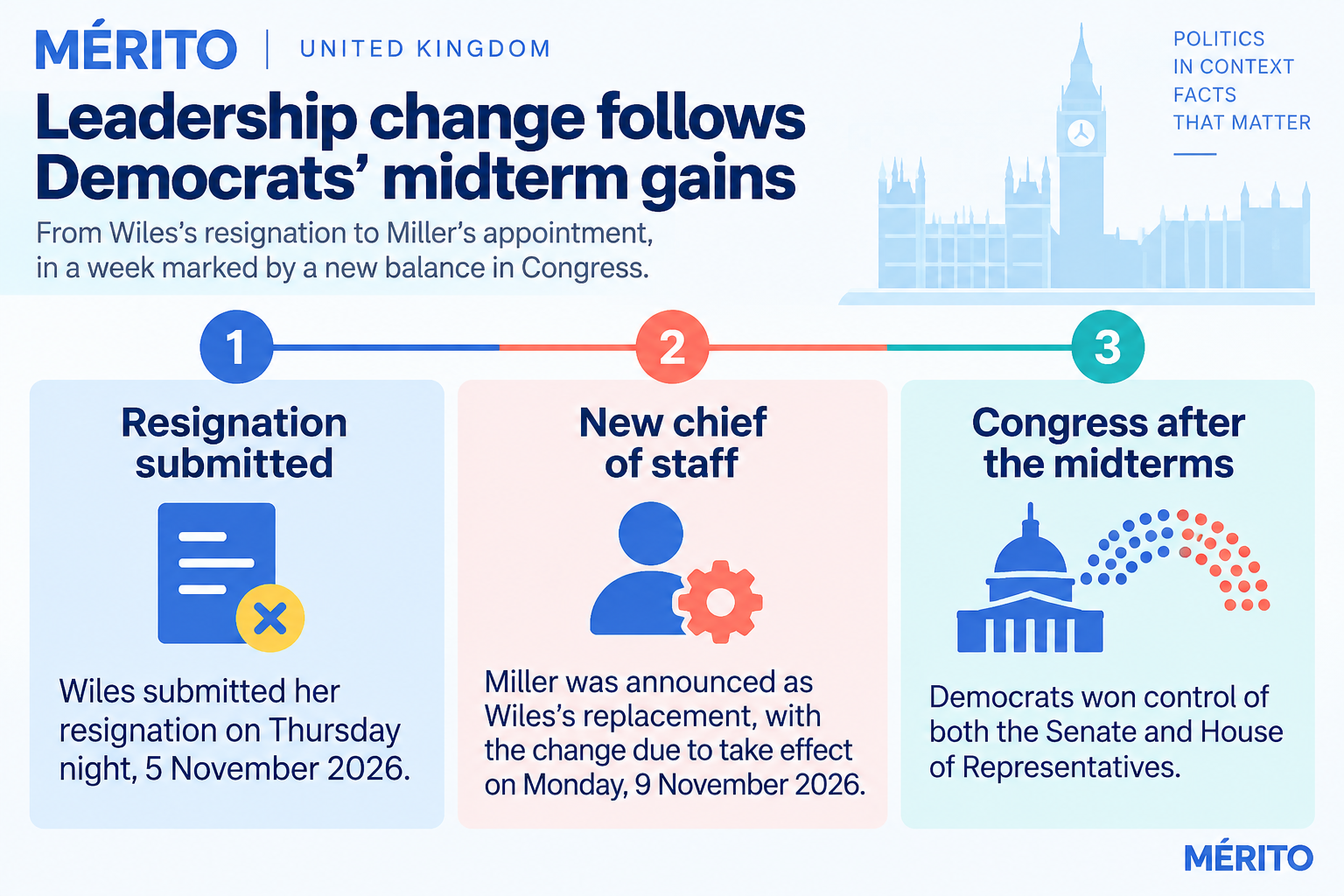
Donald Trump announced that Stephen Miller would replace Susie Wiles as White House chief of staff from 9 November 2026. Wiles submitted her resignation on Thursday night, according to officials and people familiar with the matter, and said Friday was her last day. Miller has led work on the administration’s immigration enforcement and deportation agenda.
The announced leadership change followed the midterm elections, in which Democrats won control of both chambers of Congress.
Trump announces the transition
Donald Trump announced that Stephen Miller would replace Susie Wiles as White House chief of staff, with the change due to take effect on Monday, 9 November 2026. Trump said Wiles would move to his political operation.
Trump told reporters he wanted to make a change and praised Wiles’s work. He described Miller as one of his most trusted advisers and said Miller had been with him from the beginning.
Wiles’s resignation and the timing
Wiles submitted her resignation to Trump on Thursday night, 5 November, according to an official and people familiar with the matter. Trump announced the appointment the following day. Wiles said in a public statement that 6 November was her last day as chief of staff.
In her statement, Wiles called serving in the White House the honour of a lifetime and said her commitment to Trump and his mission would not change. Trump said she would move to his political operation; the announcement gave no further details about her future role.
Miller’s position and public response
Before the appointment, Miller was deputy chief of staff and had served as a senior adviser during Trump’s first administration. He has played a leading role in the administration’s hardline immigration agenda, including enforcement and deportation.
Miller said he was honoured to serve as chief of staff and called Trump “the most transformative political leader in American History”. He thanked Wiles for her service and friendship.
The midterm political context
The transition came after the midterm elections, in which Democrats won control of both the US Senate and House of Representatives. The change gave Democrats control of Congress for the remainder of Trump’s presidency.
The timing of the resignation followed the election, but the supplied evidence does not establish that the result caused Wiles to leave her post.
Explore the background
Further reading
Selected background resources to explain the context and concepts behind this story.
Understand the constitutional role and structure of the United States Congress, including the composition of the House and Senate.
The Legislative Branch | The White House
The article mentions that Democrats won control of both chambers of Congress. This resource provides the official definition of the Legislative Branch, explaining how the House and Senate function and their relationship to the executive branch, which is essential for understanding the political context of the chief of staff change.
Review the historical significance of Susie Wiles' tenure as the first woman to serve as White House Chief of Staff.
Susie Wiles - Archives of Women's Political Communication
This academic archive entry provides a biographical overview of Susie Wiles, highlighting her historic appointment. It offers a stable, non-news perspective on her role and background, complementing the news of her resignation.
Identify Stephen Miller's previous roles and his association with the Trump administration's policy agenda.
Stephen Miller (advisor) | American Politics Wiki | Fandom
This reference page outlines Miller's career timeline and his position as an advisor. It helps the reader understand his background and the specific policy areas, such as immigration, that he has been associated with prior to becoming chief of staff.
External links selected for their educational value. They are separate from the sources used to report this story.
Editorial transparency
Article integrity
These checks apply to the published version. Changes to its content or evidence require a fresh review.
Veracidad
Aprobado
Comprueba que la pieza tenga fuentes declaradas y verificadas, que el nivel de evidencia se presente correctamente y que el desarrollo sea suficiente para sostener sus afirmaciones.
100/100
Analizado 07/11/2026 07:04 · rules-v1
Ausencia de sesgo
Aprobado
Busca lenguaje emocional, descalificaciones, generalizaciones absolutas y una voz editorial impropia de una noticia. También comprueba atribuciones y pluralidad de fuentes cuando la materia es sensible.
100/100
Analizado 07/11/2026 07:04 · rules-v1
Ausencia de clickbait
Aprobado
Evalúa si el titular cuenta el hecho principal sin ocultarlo para provocar curiosidad, sin promesas exageradas y sin recursos tipográficos engañosos.
100/100
Analizado 07/11/2026 07:04 · rules-v1
Coherencia editorial
Aprobado
Contrasta titular, subtítulo, resumen y cuerpo para detectar contradicciones, cifras sin respaldo o un alcance mayor del que permite la información disponible.
100/100
Analizado 07/11/2026 07:04 · rules-v1
Plagio y originalidad
Aprobado
Compara la prosa con los extractos de las fuentes utilizadas y con hasta 250 publicaciones recientes de Mérito para detectar copia extensa o una reescritura demasiado cercana.
100/100
Analizado 07/11/2026 07:04 · rules-v1
Conflictos de interés
Aprobado
Analiza posibles relaciones entre la autoría, el medio y las fuentes, así como patrocinio, lenguaje promocional o dependencia exclusiva de comunicados de prensa.
100/100
Analizado 07/11/2026 07:04 · rules-v1
The score is a quality-control indicator, not a probability that something is true.