Russia and Ukraine agree prisoner exchange during Abu Dhabi talks
The sides announced a large-scale swap after two days of negotiations; no figure was given, and the later Dublin meeting was part of follow-up diplomacy.
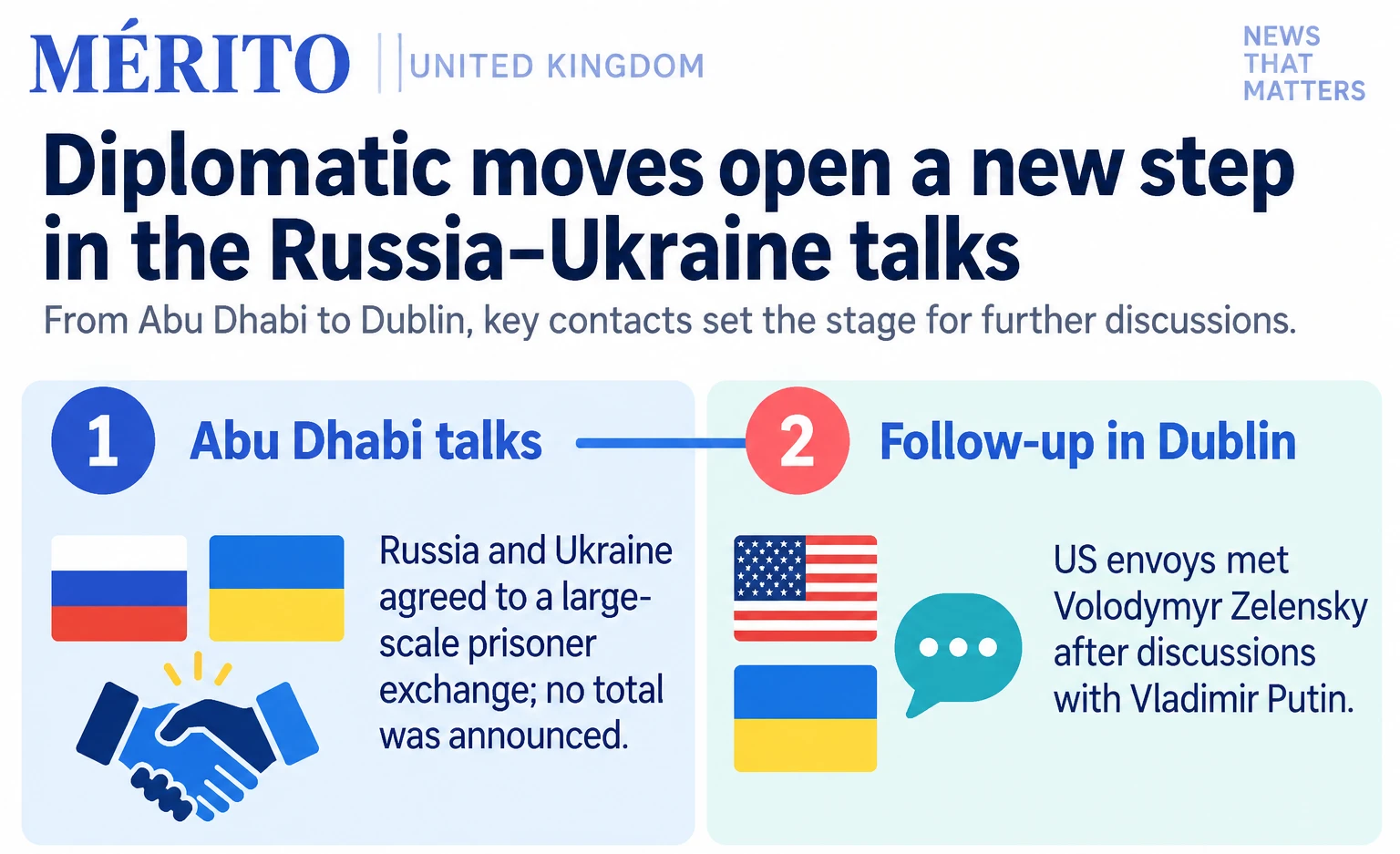
Russia and Ukraine agreed to a large-scale prisoner exchange during US-mediated talks in Abu Dhabi. No concrete number was announced. US envoys later met Volodymyr Zelensky in Dublin, where he described the exchange as a significant result and the envoys discussed further negotiations.
The agreement was announced after the Abu Dhabi talks; the subsequent Dublin meeting was part of diplomatic follow-up.
Agreement announced after Abu Dhabi talks
Russia and Ukraine agreed to a large-scale prisoner exchange during US-mediated talks in Abu Dhabi, according to statements reported after the negotiations. Neither side announced a concrete number of people covered by the agreement. The announcement came at the end of two days of discussions on ending the war.
The exchange was an agreement, not a completed transfer. At the time, the parties were still discussing its details; subsequent comments described further work ahead. The reporting does not establish that the exchange had already taken place.
Envoys continued discussions in Dublin
After the Abu Dhabi talks, US envoys Steve Witkoff and Jared Kushner travelled to meet Russian President Vladimir Putin and then Volodymyr Zelensky in Dublin. Zelensky called the prisoner-exchange agreement a “real result” and said Ukrainian soldiers would return home. Kushner said the envoys had finalised the exchange during their diplomatic work, while discussing its implementation and the people affected.
The Dublin meeting also addressed the wider negotiations. Zelensky welcomed the prospect of European representatives having a voice in future talks. US envoy Steve Witkoff said another meeting was scheduled, and that the envoys would continue working towards ending the war.
No announced total for the exchange
The Abu Dhabi announcement described the planned swap as large-scale but did not specify a number. Volodymyr Zelensky referred to a possible exchange of 1,000 people for 1,000, with the possibility of a higher figure, while noting that Kyiv was awaiting a response from Moscow. The figure was presented as a possibility, not a confirmed total.
The timing was also not settled in the material describing the agreement. One report relayed an expectation that the exchange could take place within two to three weeks, while the envoys said the number would be determined later. The available accounts therefore do not establish a final count or implementation date.
Explore the background
Further reading
Selected background resources to explain the context and concepts behind this story.
Understand the legal frameworks and international law principles governing prisoner exchanges in armed conflict.
Legal Reflections on the Russia-Ukraine Prisoner Exchange
This resource from the West Point Law School provides a structured legal analysis of the Russia-Ukraine prisoner exchange, offering insight into the regulatory and humanitarian law context that underpins such diplomatic agreements.
Review the European Parliament's official stance and documentation regarding prisoner exchanges in the context of the Ukraine conflict.
P10_TA(2025)0175 – 2023 and 2024 reports on Ukraine - EUR-Lex
As an official EU legislative document, this resource provides a stable, institutional perspective on the prisoner exchange, detailing the political and diplomatic implications recognized by the European Parliament.
Analyze the historical and implementation challenges of prisoner exchange clauses within broader peace agreements like Minsk II.
Unpacking the Implementation Challenges of the Minsk II Agreement
This academic paper offers a detailed examination of how prisoner exchange mechanisms have been integrated into previous diplomatic frameworks, providing historical context for the current negotiations.
External links selected for their educational value. They are separate from the sources used to report this story.
Editorial transparency
Article integrity
These checks apply to the published version. Changes to its content or evidence require a fresh review.
Veracidad
Aprobado
Comprueba que la pieza tenga fuentes declaradas y verificadas, que el nivel de evidencia se presente correctamente y que el desarrollo sea suficiente para sostener sus afirmaciones.
100/100
Analizado 13/11/2026 07:28 · rules-v1
Ausencia de sesgo
Aprobado
Busca lenguaje emocional, descalificaciones, generalizaciones absolutas y una voz editorial impropia de una noticia. También comprueba atribuciones y pluralidad de fuentes cuando la materia es sensible.
100/100
Analizado 13/11/2026 07:28 · rules-v1
Ausencia de clickbait
Aprobado
Evalúa si el titular cuenta el hecho principal sin ocultarlo para provocar curiosidad, sin promesas exageradas y sin recursos tipográficos engañosos.
100/100
Analizado 13/11/2026 07:28 · rules-v1
Coherencia editorial
Aprobado
Contrasta titular, subtítulo, resumen y cuerpo para detectar contradicciones, cifras sin respaldo o un alcance mayor del que permite la información disponible.
100/100
Analizado 13/11/2026 07:28 · rules-v1
Plagio y originalidad
Aprobado
Compara la prosa con los extractos de las fuentes utilizadas y con hasta 250 publicaciones recientes de Mérito para detectar copia extensa o una reescritura demasiado cercana.
100/100
Analizado 13/11/2026 07:28 · rules-v1
Conflictos de interés
Aprobado
Analiza posibles relaciones entre la autoría, el medio y las fuentes, así como patrocinio, lenguaje promocional o dependencia exclusiva de comunicados de prensa.
100/100
Analizado 13/11/2026 07:28 · rules-v1
The score is a quality-control indicator, not a probability that something is true.