
News World

Dublin summit leaders call for Europe to shape Ukraine peace efforts

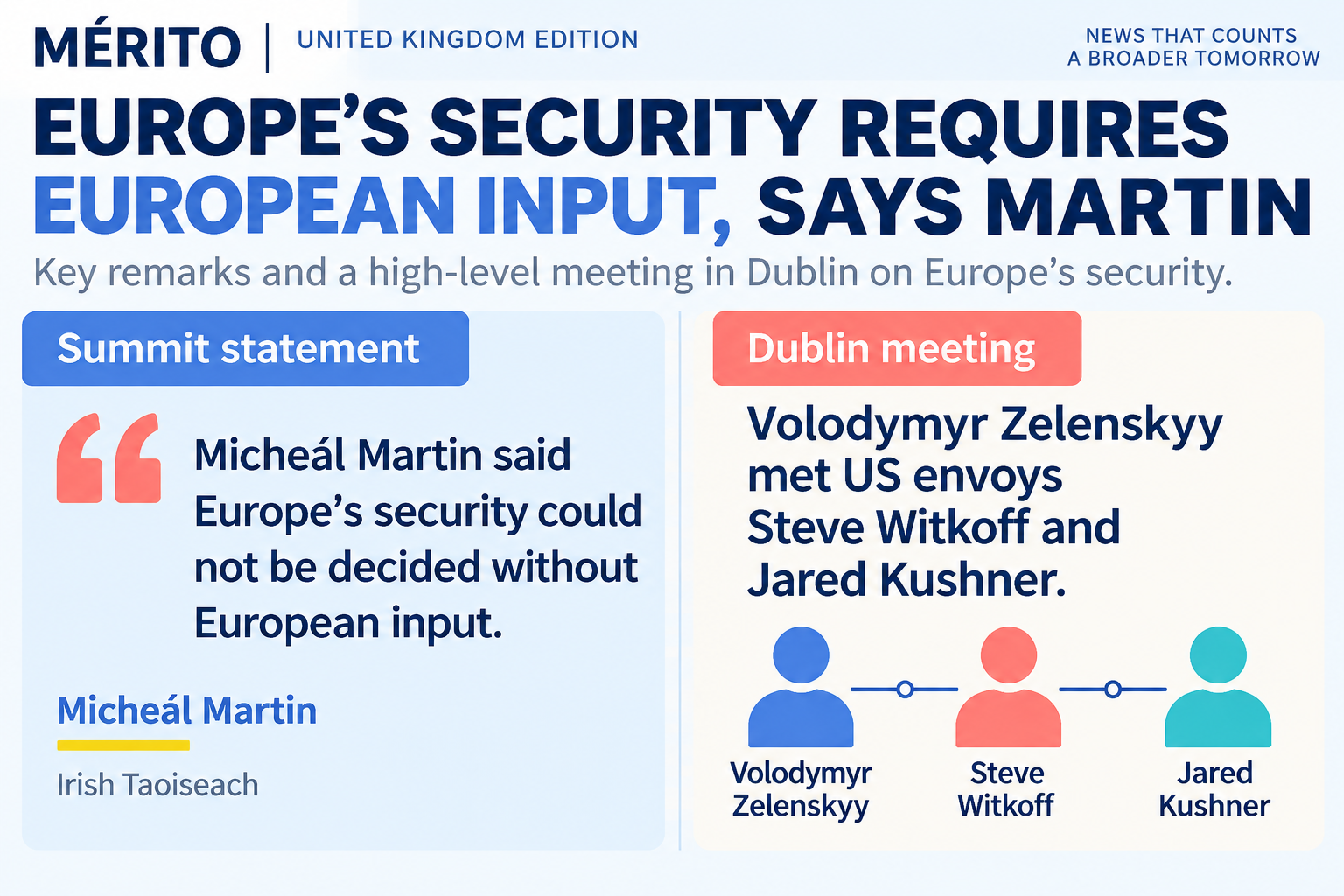
Micheál Martin said European security could not be decided without Europe, as Volodymyr Zelenskyy met US envoys in Dublin during the European Political Community gathering.

European leaders made the case for European involvement in efforts to end Russia’s war in Ukraine at the European Political Community summit in Dublin on 12 November 2026. Taoiseach Micheál Martin said the future of European security could not be decided without Europe; French President Emmanuel Macron also urged leaders to define shared security principles. Zelenskyy met US envoys Steve Witkoff and Jared Kushner in Dublin amid renewed US-led diplomatic efforts.

European leaders argue for a say in Ukraine’s future

At the European Political Community summit in Dublin on 12 November 2026, Taoiseach Micheál Martin argued that Europe must be involved in decisions about a settlement affecting the continent’s security. He said Washington and Moscow knew there could be no agreement ending the war without European input, while stressing that the terms of a ceasefire would affect countries beyond the European Union.

Martin’s comments came as European leaders gathered for the ninth meeting of the European Political Community, a forum created in 2022 to strengthen political ties among European countries after Russia’s invasion of Ukraine. The Dublin gathering included 44 European leaders, alongside heads of EU institutions and Nato’s secretary general; Canadian Prime Minister Mark Carney attended as a non-European guest.

French President Emmanuel Macron made a related appeal, urging European leaders to define what they wanted for Ukraine and for Europe’s own security. He called for shared principles and commitments, framing the issue as one of European coordination rather than announcing an agreed negotiating role.

Zelenskyy meets US envoys as diplomacy resumes

Ukrainian President Volodymyr Zelenskyy met US envoys Steve Witkoff and Jared Kushner in Dublin during the summit. The meeting took place amid renewed US-brokered efforts to pursue a settlement, after the envoys had held discussions with Russian President Vladimir Putin in Moscow, according to accounts of the diplomatic activity.

Martin cautioned against drawing firm conclusions from the talks, saying it was premature to read too much into them. He said Britain would continue supporting Ukraine and seeking European representation in the process. His remarks described a political position and an effort to influence future discussions; they did not establish that Europe had already been assigned a formal seat.

European Council President António Costa also said the future of European security could not be discussed and decided without Europe. The comments underline the distinction at the centre of the Dublin discussions: European leaders were pressing for involvement, while the form and status of any participation in future negotiations remained unsettled in the supplied reporting.

Ukraine war shapes the wider security debate

In his address to summit participants, Martin said Russia’s war had fundamentally reshaped Europe’s security environment. The meeting therefore addressed more than the immediate terms of a possible ceasefire: leaders also considered the wider security consequences for European countries, including those outside the EU.

The accounts available establish the leaders’ calls for European input and the meetings held in Dublin, but do not show that a European negotiating representative or a settled framework for Europe’s participation had been agreed at the summit.

Explore the background

Further reading

Selected background resources to explain the context and concepts behind this story.

Understand the legal framework and terminology of European security policy, including the Dublin Convention’s role in shaping collective defence initiatives.

Dublin Convention - European Commission

The glossary provides authoritative definitions and context for key concepts such as the Common Security and Defence Policy, enabling readers to grasp how European security mechanisms operate in relation to Ukraine.

ec.europa.eu

Explore the impact of Russia’s invasion on European security policy and how Ireland’s consultative forum has addressed these challenges.

Consultative Forum on International Security Policy

The report offers an official analysis of post‑invasion security strategies, detailing Ireland’s contributions to European policy discussions and the broader diplomatic efforts highlighted at the Dublin summit.

assets.gov.ie

Learn how Ireland’s military doctrine integrates European security principles into national defence planning and crisis response.

irljp-01 - military doctrine for the irish defence forces

The Irish Defence Forces’ doctrine outlines the nation’s approach to maintaining peace and security within European frameworks, providing concrete examples of how national policies align with the summit’s calls for collective action.

military.ie

External links selected for their educational value. They are separate from the sources used to report this story.

Editorial transparency

Article integrity

These checks apply to the published version. Changes to its content or evidence require a fresh review.

Veracidad

Aprobado

Comprueba que la pieza tenga fuentes declaradas y verificadas, que el nivel de evidencia se presente correctamente y que el desarrollo sea suficiente para sostener sus afirmaciones.

100/100

Analizado 13/11/2026 03:43 · rules-v1

Ausencia de sesgo

Aprobado

Busca lenguaje emocional, descalificaciones, generalizaciones absolutas y una voz editorial impropia de una noticia. También comprueba atribuciones y pluralidad de fuentes cuando la materia es sensible.

100/100

Analizado 13/11/2026 03:43 · rules-v1

Ausencia de clickbait

Aprobado

Evalúa si el titular cuenta el hecho principal sin ocultarlo para provocar curiosidad, sin promesas exageradas y sin recursos tipográficos engañosos.

100/100

Analizado 13/11/2026 03:43 · rules-v1

Coherencia editorial

Aprobado

Contrasta titular, subtítulo, resumen y cuerpo para detectar contradicciones, cifras sin respaldo o un alcance mayor del que permite la información disponible.

100/100

Analizado 13/11/2026 03:43 · rules-v1

Plagio y originalidad

Aprobado

Compara la prosa con los extractos de las fuentes utilizadas y con hasta 250 publicaciones recientes de Mérito para detectar copia extensa o una reescritura demasiado cercana.

100/100

Analizado 13/11/2026 03:43 · rules-v1

Conflictos de interés

Aprobado

Analiza posibles relaciones entre la autoría, el medio y las fuentes, así como patrocinio, lenguaje promocional o dependencia exclusiva de comunicados de prensa.

100/100

Analizado 13/11/2026 03:43 · rules-v1

The score is a quality-control indicator, not a probability that something is true.