Canada and EU launch Alliance for the Future, short of membership
The summit statement sets out closer ties on digital trade, research, security and critical raw materials, while committing the sides to define closer association by 2027.
Canada and the European Union launched an Alliance for the Future at their 21st summit in Montréal on 30 October 2026. Their joint statement commits them to closer cooperation and to working towards defining a closer association by the 2027 summit; it does not make Canada an EU member or grant associate-member status.
The summit launched a new framework for cooperation, not Canadian membership of the EU.
A new alliance, not a membership decision
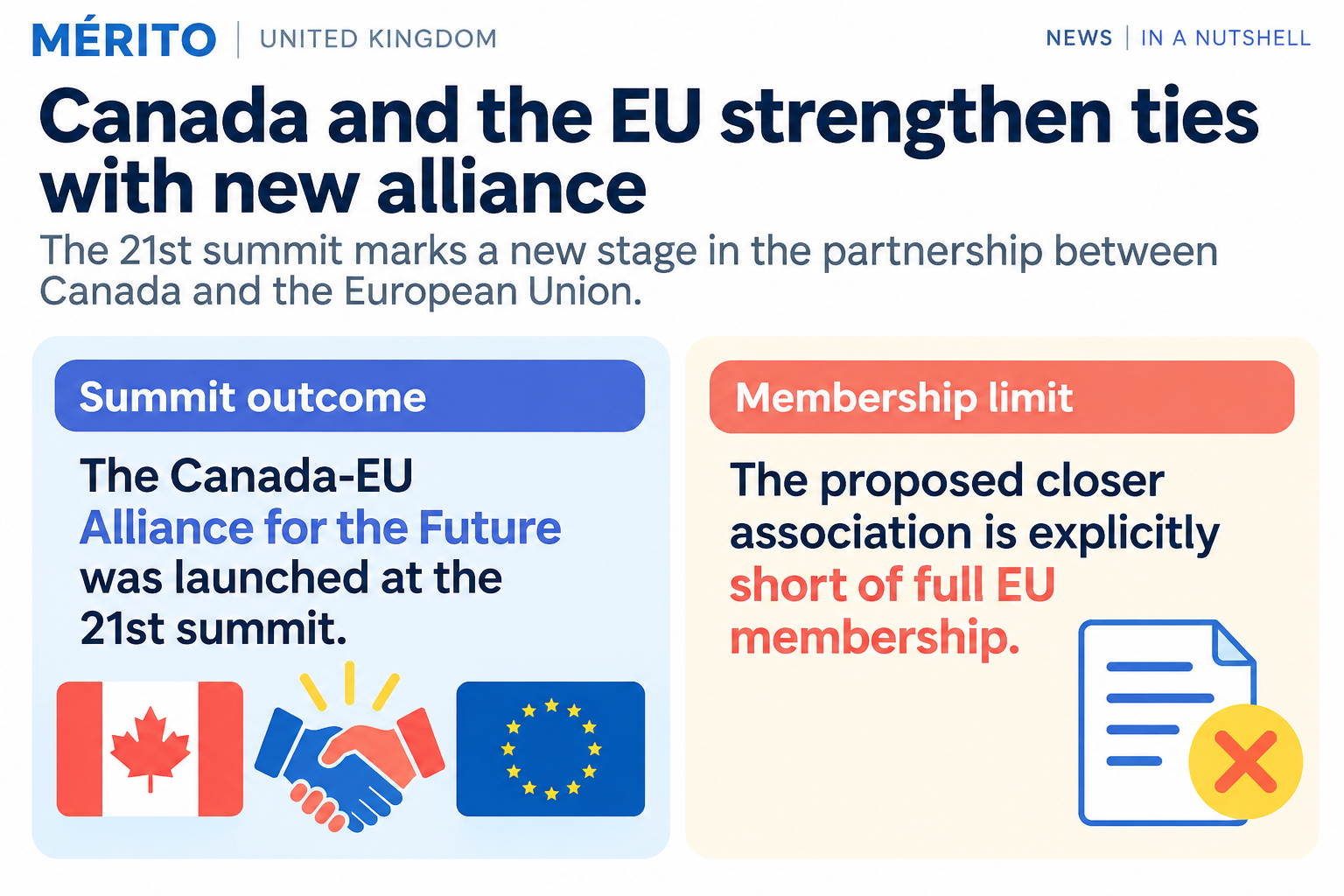
Canada and the European Union launched the Canada-EU Alliance for the Future at their 21st summit in Montréal on 30 October 2026. The joint statement frames it as a way to build shared prosperity and economic security through closer cooperation.
The statement commits the sides to create an even closer association, while making clear that this would be short of full EU membership. They will work towards defining the concept by the 2027 summit. The announcement establishes a work programme, not a new membership status.
Cooperation spans trade, research and security
One concrete area is digital trade. The leaders’ statement records that the sides have concluded a Digital Trade Agreement, intended to improve legal certainty, facilitate cross-border data flows and increase confidence in the digital economy for businesses and consumers.
On research, Canada and the EU will work towards Canadian participation in future European research and innovation programmes, including Horizon Europe. They also plan to expand Canada’s use of existing opportunities under the Marie Skłodowska-Curie Actions and the European Research Council. The statement links this work to expanded exchanges and researcher mobility between Canada and the EU, as well as collaborative research and innovation in areas including artificial intelligence, quantum technologies, semiconductors, photonics and advanced computing. These are commitments to develop participation and cooperation, not evidence that every programme change has already taken effect.
The alliance also sets out expanded security and defence cooperation, including maritime and space security, crisis management and responses to hybrid threats. On supply chains, the two sides committed to developing secure, sustainable critical raw-material value chains and exploring ways to integrate them.
Explore the background
Further reading
Selected background resources to explain the context and concepts behind this story.
Understand the framework and general annexes governing Horizon Europe work programmes for 2026–2027.
EN Annex XV Horizon Europe Work Programme 2026-2027 ...
The article identifies research programmes as an area of Canada-EU cooperation; this European Commission resource provides a reference point for Horizon Europe’s programme framework.
Learn how the EU frames strategic projects under its Critical Raw Materials Act.
Strategic projects under the Critical Raw Materials Act
The article mentions cooperation on critical raw-material supply chains. This EU document’s title and extract connect that topic to the Act’s supply-security framework.
Learn the basics of Canada’s participation in Horizon Europe as an associated country.
Horizon Europe Made Easy: Your Guide to Accessing ...
The article says the planned closer association is not EU membership or associate-member status. This guide addresses a distinct form of association—participation in Horizon Europe—and helps clarify that programme context.
Understand how European innovation partnerships relate to trade arrangements between Canada and the EU.
European innovation partnerships: A guide for Canadian ...
The guide is intended for Canadian small and medium-sized enterprises and notes that CETA facilitates trade. It offers a practical background on Canada-EU economic links beyond the new alliance.
External links selected for their educational value. They are separate from the sources used to report this story.
Editorial transparency
Article integrity
These checks apply to the published version. Changes to its content or evidence require a fresh review.
Veracidad
Aprobado
Comprueba que la pieza tenga fuentes declaradas y verificadas, que el nivel de evidencia se presente correctamente y que el desarrollo sea suficiente para sostener sus afirmaciones.
100/100
Analizado 30/10/2026 17:21 · rules-v1
Ausencia de sesgo
Aprobado
Busca lenguaje emocional, descalificaciones, generalizaciones absolutas y una voz editorial impropia de una noticia. También comprueba atribuciones y pluralidad de fuentes cuando la materia es sensible.
100/100
Analizado 30/10/2026 17:21 · rules-v1
Ausencia de clickbait
Aprobado
Evalúa si el titular cuenta el hecho principal sin ocultarlo para provocar curiosidad, sin promesas exageradas y sin recursos tipográficos engañosos.
100/100
Analizado 30/10/2026 17:21 · rules-v1
Coherencia editorial
Aprobado
Contrasta titular, subtítulo, resumen y cuerpo para detectar contradicciones, cifras sin respaldo o un alcance mayor del que permite la información disponible.
100/100
Analizado 30/10/2026 17:21 · rules-v1
Plagio y originalidad
Aprobado
Compara la prosa con los extractos de las fuentes utilizadas y con hasta 250 publicaciones recientes de Mérito para detectar copia extensa o una reescritura demasiado cercana.
100/100
Analizado 30/10/2026 17:21 · rules-v1
Conflictos de interés
Aprobado
Analiza posibles relaciones entre la autoría, el medio y las fuentes, así como patrocinio, lenguaje promocional o dependencia exclusiva de comunicados de prensa.
100/100
Analizado 30/10/2026 17:21 · rules-v1
The score is a quality-control indicator, not a probability that something is true.