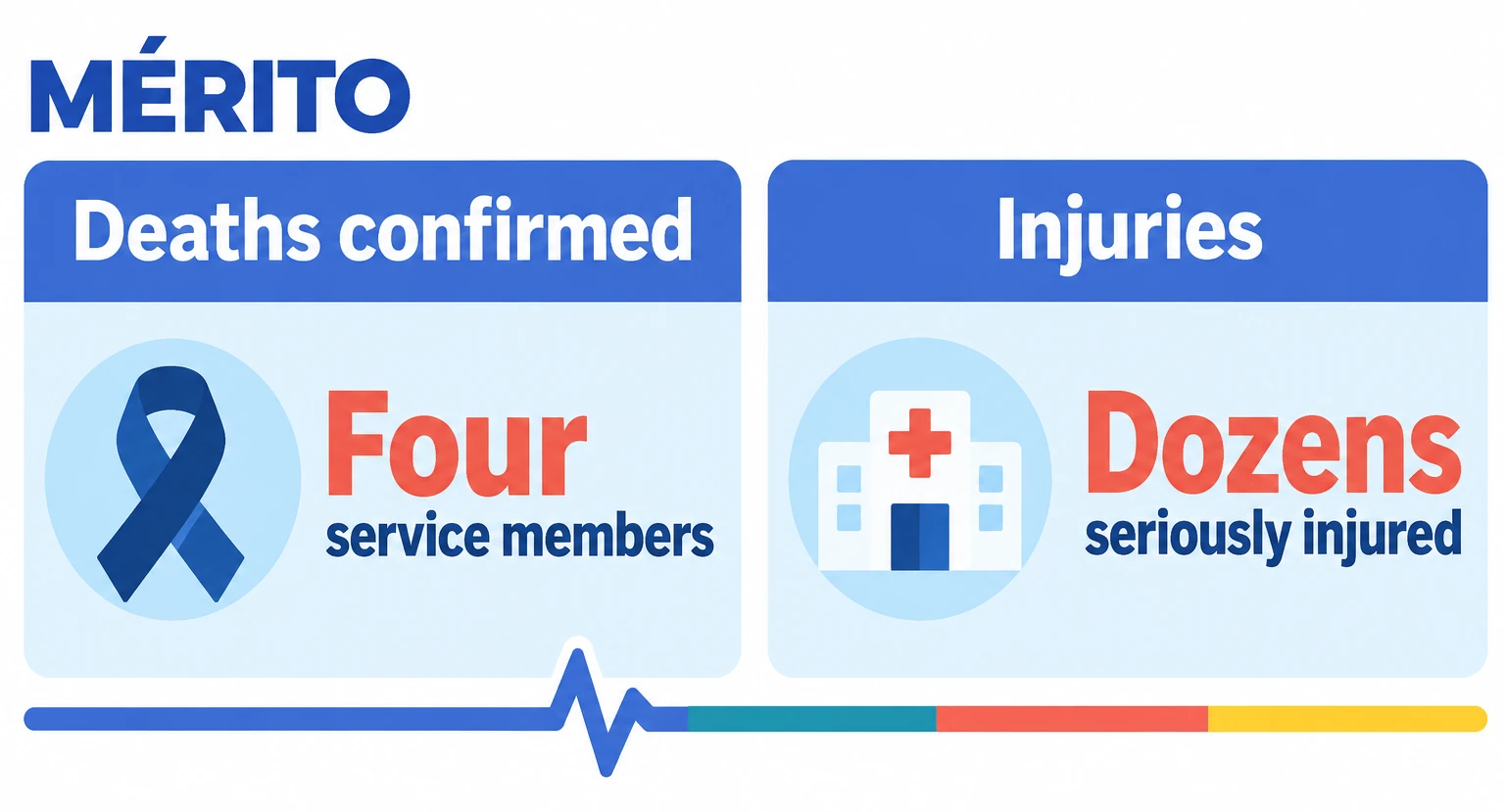
Four service members died in Wainwright base fire, Carney confirmed
The fire broke out during military training in Alberta on 17 October 2026; dozens were seriously injured and the cause remained under investigation.
A fire at Canadian Forces Base Wainwright spread beyond the Alberta training site during high winds on 17 October 2026. Prime Minister Mark Carney later confirmed that four service members had died and dozens were seriously injured. Emergency services and hospitals across the province responded, while authorities investigated the cause.
The fire occurred at Canadian Forces Base Wainwright during military training.
Fire during military training
A fire broke out in a training area at Canadian Forces Base Wainwright in Alberta on 17 October 2026, while service members were taking part in military training. It spread beyond the base into surrounding rural areas as strong winds fanned the flames.
Prime Minister Mark Carney confirmed on 18 October that four service members had died and dozens more had been seriously injured. Their families had been notified. The injured were being treated in Wainwright, Edmonton, Red Deer and Calgary.
Emergency response and investigation
The Royal Canadian Mounted Police said officers were called shortly after 4pm on 17 October following reports of a fire in the base’s training area. Military and civilian crews fought the blaze overnight. By 11pm, the Municipal District of Wainwright said the fire was being held and that property and critical infrastructure were protected; no evacuation order had been issued for residents.
Acute Care Alberta said several hospitals activated a Code Orange to co-ordinate care for multiple seriously injured patients. The provincial health service later said the coordinated emergency response involved 22 ground ambulances and eight aircraft; all Code Orange activations had been stood down by 18 October, and normal acute-care operations had resumed.
The cause remained under investigation. The supplied information does not establish what started the fire; the Department of National Defence said there were no indications that it resulted from terrorist activity.
Explore the background
Further reading
Selected background resources to explain the context and concepts behind this story.
Understand the standard abbreviations and organizational designations used in Canadian military and police records.
Military abbreviations used in service files
This official Library and Archives Canada resource provides a stable reference for decoding acronyms like RCMP and RCN, which are essential for navigating official documents related to the Canadian Armed Forces and the Royal Canadian Mounted Police mentioned in the news.
Gain a foundational understanding of the support structures and organizational hierarchy within the Canadian military.
A Family Guide to the MILITARY EXPERIENCE
The 'Family Guide to the Military Experience' serves as an educational document that outlines the roles of various organizations, including the RCMP and military colleges, helping readers understand the broader institutional context in which the service members operate.
Clarify the specific roles and responsibilities of the Canadian Forces Provost Marshal in relation to the RCMP.
CANADIAN FORCES PROVOST MARSHAL
This official government publication details the organizational structure and duties of the military police, providing necessary background on how security and policing functions are divided between the Canadian Forces and the Royal Canadian Mounted Police.
External links selected for their educational value. They are separate from the sources used to report this story.
Editorial transparency
Article integrity
These checks apply to the published version. Changes to its content or evidence require a fresh review.
Veracidad
Aprobado
Comprueba que la pieza tenga fuentes declaradas y verificadas, que el nivel de evidencia se presente correctamente y que el desarrollo sea suficiente para sostener sus afirmaciones.
100/100
Analizado 18/10/2026 21:36 · rules-v1
Ausencia de sesgo
Aprobado
Busca lenguaje emocional, descalificaciones, generalizaciones absolutas y una voz editorial impropia de una noticia. También comprueba atribuciones y pluralidad de fuentes cuando la materia es sensible.
100/100
Analizado 18/10/2026 21:36 · rules-v1
Ausencia de clickbait
Aprobado
Evalúa si el titular cuenta el hecho principal sin ocultarlo para provocar curiosidad, sin promesas exageradas y sin recursos tipográficos engañosos.
100/100
Analizado 18/10/2026 21:36 · rules-v1
Coherencia editorial
Aprobado
Contrasta titular, subtítulo, resumen y cuerpo para detectar contradicciones, cifras sin respaldo o un alcance mayor del que permite la información disponible.
100/100
Analizado 18/10/2026 21:36 · rules-v1
Plagio y originalidad
Aprobado
Compara la prosa con los extractos de las fuentes utilizadas y con hasta 250 publicaciones recientes de Mérito para detectar copia extensa o una reescritura demasiado cercana.
100/100
Analizado 18/10/2026 21:36 · rules-v1
Conflictos de interés
Aprobado
Analiza posibles relaciones entre la autoría, el medio y las fuentes, así como patrocinio, lenguaje promocional o dependencia exclusiva de comunicados de prensa.
100/100
Analizado 18/10/2026 21:36 · rules-v1
The score is a quality-control indicator, not a probability that something is true.