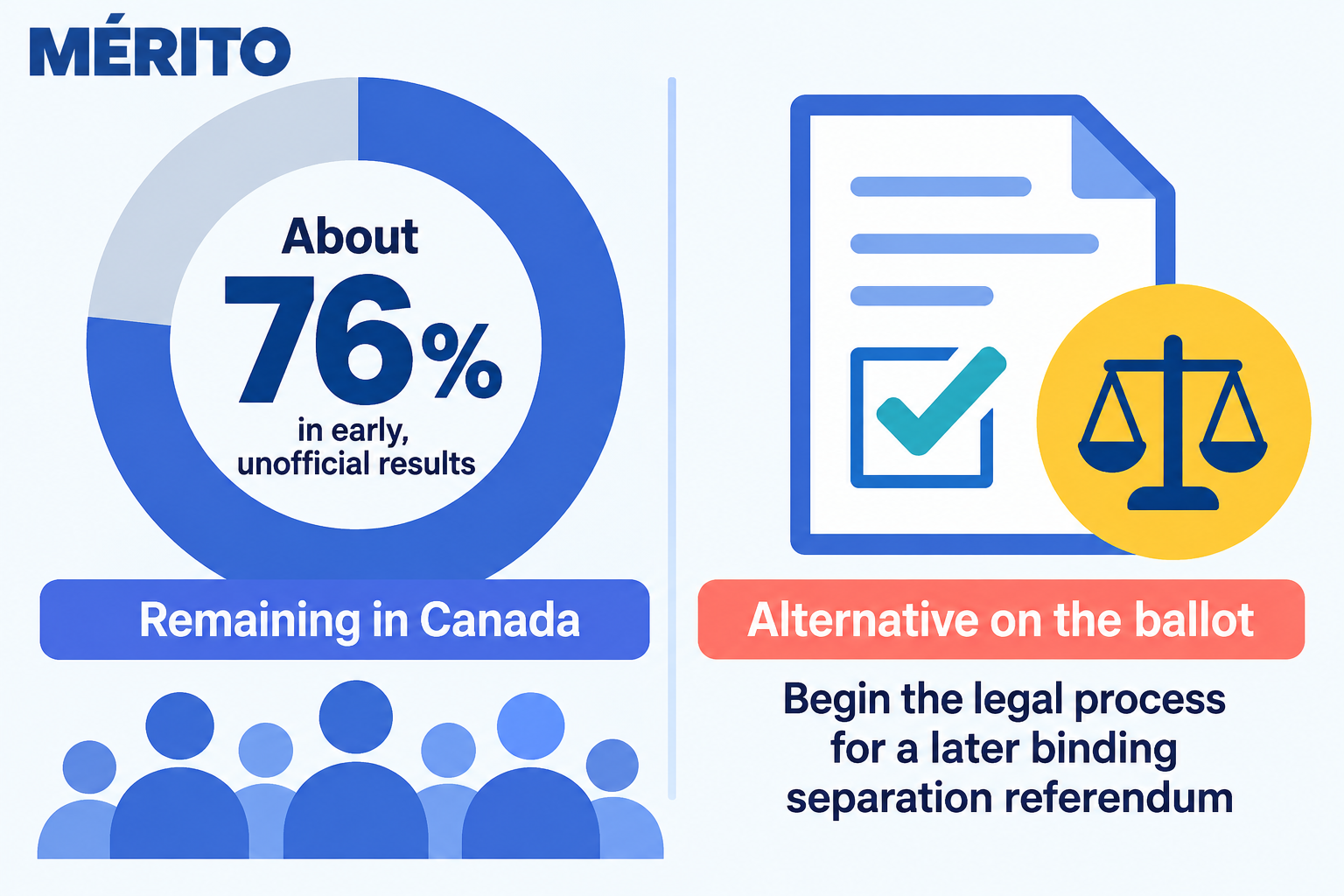
About 76% backed staying in Canada, while the ballot’s alternative was to start a legal process for a later binding separation referendum.
Early, unofficial results in Alberta’s referendum showed about 76% of votes cast for remaining in Canada and close to 24% for beginning the process towards a possible later referendum on separation. The ballot did not itself decide whether Alberta would leave Canada.
The referendum question did not itself decide separation from Canada.
Early count favours remaining in Canada
Early, unofficial results from Alberta’s referendum showed about 76% of votes cast for remaining in Canada, with close to 24% supporting the alternative, as more than 1.5 million votes had been counted. The figures were reported while counting was under way, rather than as a final certified result.
Advance and special ballots had already brought in more than 1.35 million votes, or about 43% of eligible voters, before polling day, according to the reported figures. Results were delayed after late openings led more than 100 polling stations to extend voting hours.
The ballot was about a process, not immediate separation
The ballot asked whether Alberta should remain a province of Canada or whether its government should begin the legal process required to hold a future binding referendum on separation. A vote for the second option would not itself have taken Alberta out of Canada.
The Government of Alberta’s ballot explanation said that majority support for starting the process would lead the government to take the legal steps needed for a later referendum. It also described a court decision requiring consultation with First Nations before a binding separation referendum could be held.
Reactions to the early results
Prime Minister Mark Carney said Albertans had chosen unity and said the result would allow Canadians to move forward together. Premier Danielle Smith welcomed the early figures, saying they showed widespread support for remaining in Canada.
The early count did not end the separatist movement. Separatist leader Keith Wilson said the numbers could change and argued that many Albertans wanted the province to be treated better. The reported statements reflect the speakers’ views, not a final assessment of the referendum’s political consequences.
Explore the background
Further reading
Selected background resources to explain the context and concepts behind this story.
Understand the historical context and legal framework of referendums in Canada.
Referendums in Canada - Wikipedia
This resource provides a broad overview of referendums at the federal and provincial levels, helping readers understand how the 2026 Alberta vote fits into the broader Canadian tradition of direct democracy.
Identify the role and mandate of the organization administering the referendum.
About Elections Alberta - Elections Alberta
As the official profile of Elections Alberta, this page clarifies the non-partisan nature of the body responsible for the vote, distinguishing it from federal or municipal election authorities.
This official documentation from the Alberta King’s Printer outlines the legal basis and authorities under the Election Act, providing a stable reference for the procedural rules applied during the vote.
Analyze the legal and political complexities of separation referendums in Canada.
1995 Quebec referendum - Wikipedia
By examining the 1995 Quebec referendum, readers can gain comparative insight into the legal ambiguities and federal-provincial tensions that often accompany questions of provincial separation.
External links selected for their educational value. They are separate from the sources used to report this story.
Editorial transparency
Article integrity
These checks apply to the published version. Changes to its content or evidence require a fresh review.
Veracidad
Aprobado
Comprueba que la pieza tenga fuentes declaradas y verificadas, que el nivel de evidencia se presente correctamente y que el desarrollo sea suficiente para sostener sus afirmaciones.
100/100
Analizado 20/10/2026 10:35 · rules-v1
Ausencia de sesgo
Aprobado
Busca lenguaje emocional, descalificaciones, generalizaciones absolutas y una voz editorial impropia de una noticia. También comprueba atribuciones y pluralidad de fuentes cuando la materia es sensible.
100/100
Analizado 20/10/2026 10:35 · rules-v1
Ausencia de clickbait
Aprobado
Evalúa si el titular cuenta el hecho principal sin ocultarlo para provocar curiosidad, sin promesas exageradas y sin recursos tipográficos engañosos.
100/100
Analizado 20/10/2026 10:35 · rules-v1
Coherencia editorial
Aprobado
Contrasta titular, subtítulo, resumen y cuerpo para detectar contradicciones, cifras sin respaldo o un alcance mayor del que permite la información disponible.
100/100
Analizado 20/10/2026 10:35 · rules-v1
Plagio y originalidad
Aprobado
Compara la prosa con los extractos de las fuentes utilizadas y con hasta 250 publicaciones recientes de Mérito para detectar copia extensa o una reescritura demasiado cercana.
100/100
Analizado 20/10/2026 10:35 · rules-v1
Conflictos de interés
Aprobado
Analiza posibles relaciones entre la autoría, el medio y las fuentes, así como patrocinio, lenguaje promocional o dependencia exclusiva de comunicados de prensa.
100/100
Analizado 20/10/2026 10:35 · rules-v1
The score is a quality-control indicator, not a probability that something is true.