Local ceasefire begins around Russian-occupied Oleshky
The pause started on 27 October, two days before its initially announced date, to enable aid and preparations for civilian evacuation.
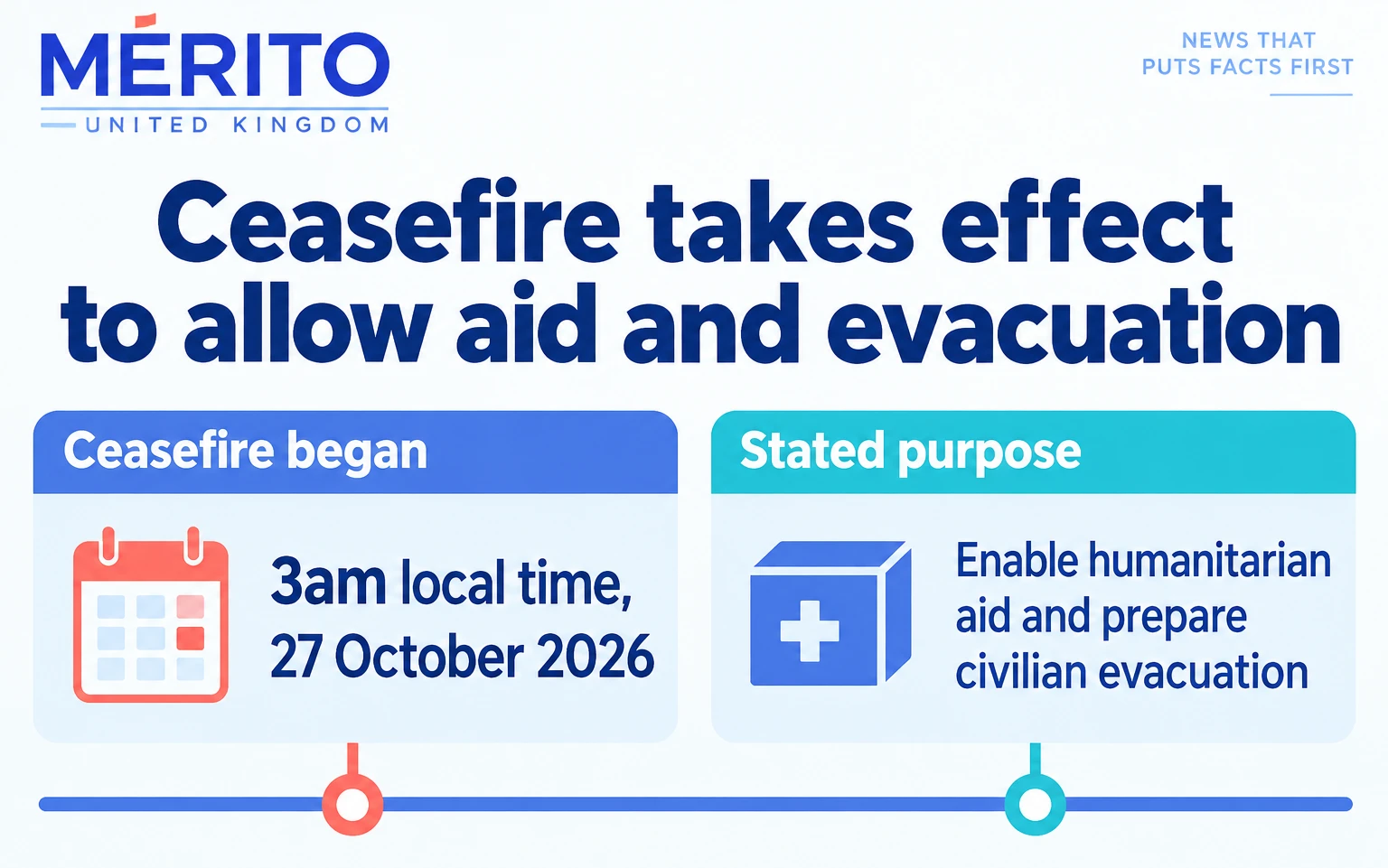
Russia and Ukraine began observing a local ceasefire around Oleshky in Ukraine’s Kherson region at 3am local time on 27 October 2026. The arrangement was intended to facilitate humanitarian aid and prepare an evacuation, but did not halt attacks elsewhere in Ukraine.
The local ceasefire began on 27 October, ahead of the date first announced, to facilitate humanitarian assistance and evacuation preparations.
A local ceasefire for humanitarian access
A local ceasefire between Russia and Ukraine began around Oleshky at 3am local time on 27 October 2026. Ukrainian and Russian officials reported that their forces had stopped firing in connection with the planned humanitarian operation.
The White House had initially announced that the ceasefire would begin on 29 October. It took effect two days earlier; Melania Trump said the change was made to protect civilians and facilitate the delivery of humanitarian aid.
The White House said Melania Trump and her representative worked directly with Russian and Ukrainian leadership to define the ceasefire terms. It said she initiated discussions with both countries and aligned the parties on the agreement’s objectives, procedures and timing.
The arrangement was intended to allow aid into Oleshky and prepare a civilian evacuation through a safe passageway. The White House said civilian representatives from both countries were to visit residents to assess their needs, with co-ordinated support and transport planned for people wishing to leave. These were stated plans: the available accounts do not establish that the visits, deliveries or evacuations were completed.
The front-line setting and limits of the pause
Oleshky is in Ukraine’s Kherson region, on the Russian-occupied side of the Dnipro River, opposite Ukrainian-held Kherson. Russian forces seized the city in the early days of the full-scale invasion in 2022. Before the war, Oleshky had a population of about 24,000.
Reports described acute shortages of food and medicine in the occupied city. Movement and routes out were hazardous, with mines and drone attacks cited as obstacles. Estimates of how many people remain differ, so no single current population figure is used here.
The ceasefire was limited to the Oleshky area and did not stop fighting elsewhere in Ukraine. Attacks continued in other cities, including Kyiv, as the humanitarian pause began.
Explore the background
Further reading
Selected background resources to explain the context and concepts behind this story.
Understand Melania Trump's background and her place among US first ladies.
(45) Melania Trump | The American Presidency Project
The American Presidency Project description provides biographical context, including her birthplace and distinction as only the second first lady born outside the United States; it does not explain her role in this ceasefire.
Learn the basic public roles and biographical details associated with Melania Trump.
Meet First Lady Melania Trump
This ShareAmerica page is presented as an introduction to the first lady and describes her as a mother, model, author and businesswoman, offering general background rather than details about the ceasefire.
Explore an example of humanitarian aid distribution in Ukraine and the populations it is intended to support.
HIV INFECTION IN UKRAIN
The extract says that 100% LIFE distributes and controls humanitarian aid from UN agencies to vulnerable key populations. This provides a limited, distinct example of aid distribution, but is not a guide to the Oleshky operation.
External links selected for their educational value. They are separate from the sources used to report this story.
Editorial transparency
Article integrity
These checks apply to the published version. Changes to its content or evidence require a fresh review.
Veracidad
Aprobado
Comprueba que la pieza tenga fuentes declaradas y verificadas, que el nivel de evidencia se presente correctamente y que el desarrollo sea suficiente para sostener sus afirmaciones.
100/100
Analizado 28/10/2026 01:18 · rules-v1
Ausencia de sesgo
Aprobado
Busca lenguaje emocional, descalificaciones, generalizaciones absolutas y una voz editorial impropia de una noticia. También comprueba atribuciones y pluralidad de fuentes cuando la materia es sensible.
100/100
Analizado 28/10/2026 01:18 · rules-v1
Ausencia de clickbait
Aprobado
Evalúa si el titular cuenta el hecho principal sin ocultarlo para provocar curiosidad, sin promesas exageradas y sin recursos tipográficos engañosos.
100/100
Analizado 28/10/2026 01:18 · rules-v1
Coherencia editorial
Aprobado
Contrasta titular, subtítulo, resumen y cuerpo para detectar contradicciones, cifras sin respaldo o un alcance mayor del que permite la información disponible.
100/100
Analizado 28/10/2026 01:18 · rules-v1
Plagio y originalidad
Aprobado
Compara la prosa con los extractos de las fuentes utilizadas y con hasta 250 publicaciones recientes de Mérito para detectar copia extensa o una reescritura demasiado cercana.
100/100
Analizado 28/10/2026 01:18 · rules-v1
Conflictos de interés
Aprobado
Analiza posibles relaciones entre la autoría, el medio y las fuentes, así como patrocinio, lenguaje promocional o dependencia exclusiva de comunicados de prensa.
100/100
Analizado 28/10/2026 01:18 · rules-v1
The score is a quality-control indicator, not a probability that something is true.