Two people died in light aircraft crash near Drymen
The Piper Tomahawk II came down near Loch Lomond on 16 October 2026; the 80-year-old victim was identified locally as flying instructor Ian Haggis.
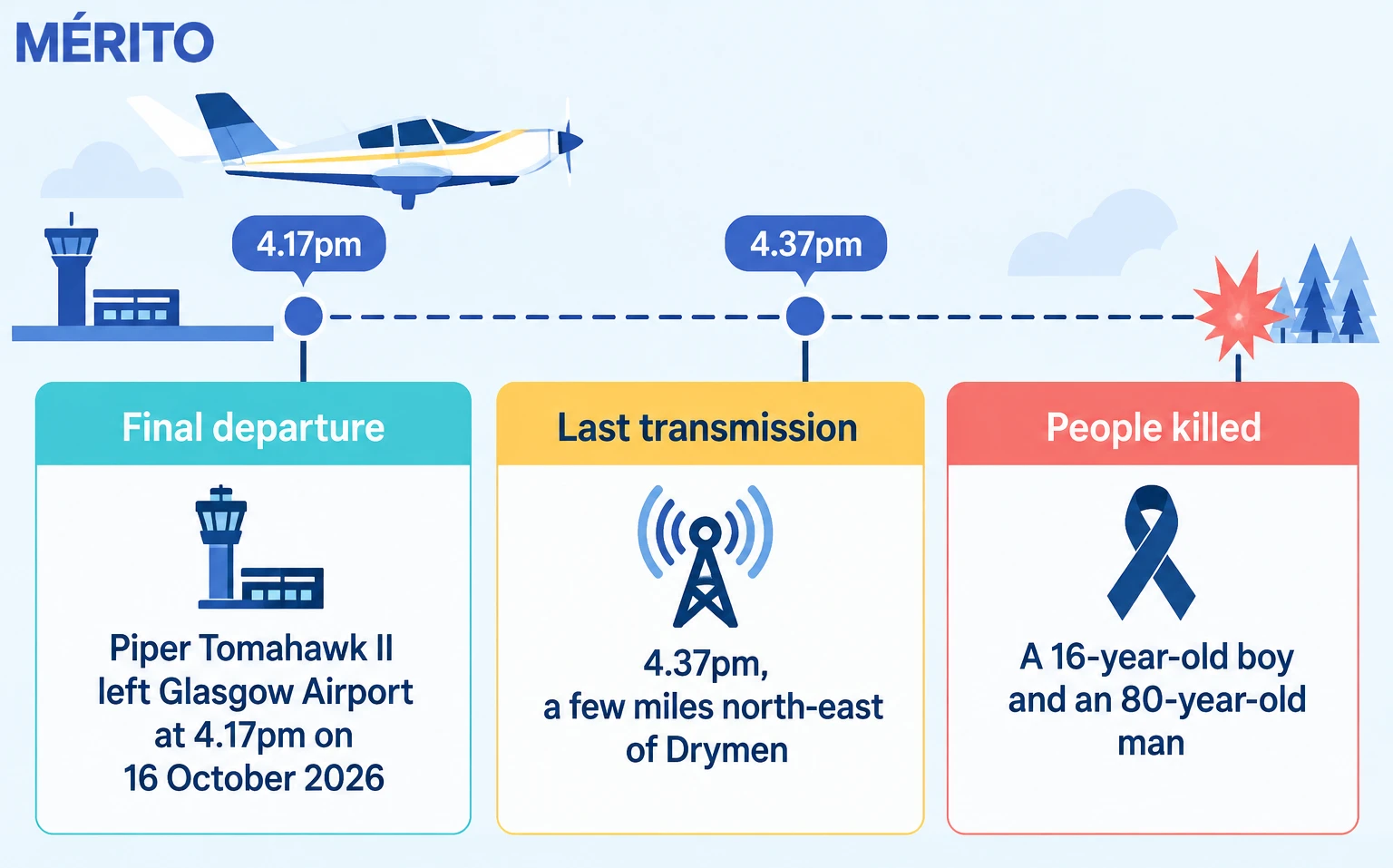
A Piper Tomahawk II crashed north-east of Drymen on 16 October 2026, killing a 16-year-old boy and an 80-year-old man. The older victim was identified locally as flying instructor Ian Haggis. The aircraft had taken off from Glasgow Airport at 4.17pm and stopped transmitting at 4.37pm, according to flight-tracking data. The Air Accidents Investigation Branch opened an investigation and temporary airspace restrictions were put in place.
The aircraft's last recorded transmission was about eight minutes before emergency services were called to the crash.
Crash near Drymen
A light aircraft crashed north-east of Drymen, near Loch Lomond, on 16 October 2026. Police Scotland said officers received a report of the crash at about 4.45pm. Emergency services attended and pronounced a 16-year-old boy and an 80-year-old man dead at the scene; their next of kin were informed.
The older victim was identified locally as Ian Haggis, an 80-year-old flying instructor. The available accounts do not record an official confirmation of his identity. The 16-year-old has not been identified in the supplied reports.
Aircraft and flight timeline
The aircraft was a Piper Tomahawk II. It departed Glasgow Airport at 4.17pm on its final flight and stopped transmitting at 4.37pm, a few miles north-east of Drymen, according to flight-tracking data. Emergency services were called about eight minutes later. Other accounts describe the departure as shortly after 4.15pm.
Earlier on 16 October, the aircraft flew from Cumbernauld Airport to Glasgow, then north-east to Newport-on-Tay before returning to Glasgow. It remained on the ground there for just over an hour before its final departure. Available accounts differ on some details of the earlier journey, so no more precise timetable is stated here.
Investigation and airspace restrictions
The Air Accidents Investigation Branch opened a safety investigation and sent a team to the crash site near Drymen to make inquiries and gather evidence. The cause of the crash had not been established in the available accounts.
Police Scotland said temporary airspace restrictions were imposed over the Drymen area to allow the investigation to proceed. The restrictions included drones, and police warned that flying in restricted airspace was a criminal offence.
Gavin Birch-Williams, managing director of Glasgow Airport, said the aircraft had departed from the airport and expressed sympathy to the people affected.
Explore the background
Further reading
Selected background resources to explain the context and concepts behind this story.
Understand the geographical and administrative context of Drymen within the East Loch Lomond area.
EAST LOCH LOMOND | PLACE PROFILE
This place profile provides stable, factual information about Drymen as a services hub, helping the reader locate the crash site within the broader regional geography of Scotland.
Gain insight into the operational infrastructure and planning of Glasgow Airport, the departure point of the aircraft.
Glasgow Airport Draft Master Plan 2011
The Draft Master Plan is a stable official document that outlines the airport's layout and development, offering context on the facility from which the Piper Tomahawk II departed.
Access official demographic and statistical data for Scotland to understand the population context of the region.
Statistics and data - National Records of Scotland (NRS)
National Records of Scotland is the authoritative source for statistical data in the country, providing a reliable reference for understanding the demographic landscape of the area where the incident occurred.
External links selected for their educational value. They are separate from the sources used to report this story.
Editorial transparency
Article integrity
These checks apply to the published version. Changes to its content or evidence require a fresh review.
Veracidad
Aprobado
Comprueba que la pieza tenga fuentes declaradas y verificadas, que el nivel de evidencia se presente correctamente y que el desarrollo sea suficiente para sostener sus afirmaciones.
100/100
Analizado 18/10/2026 15:30 · rules-v1
Ausencia de sesgo
Aprobado
Busca lenguaje emocional, descalificaciones, generalizaciones absolutas y una voz editorial impropia de una noticia. También comprueba atribuciones y pluralidad de fuentes cuando la materia es sensible.
100/100
Analizado 18/10/2026 15:30 · rules-v1
Ausencia de clickbait
Aprobado
Evalúa si el titular cuenta el hecho principal sin ocultarlo para provocar curiosidad, sin promesas exageradas y sin recursos tipográficos engañosos.
100/100
Analizado 18/10/2026 15:30 · rules-v1
Coherencia editorial
Aprobado
Contrasta titular, subtítulo, resumen y cuerpo para detectar contradicciones, cifras sin respaldo o un alcance mayor del que permite la información disponible.
100/100
Analizado 18/10/2026 15:30 · rules-v1
Plagio y originalidad
Aprobado
Compara la prosa con los extractos de las fuentes utilizadas y con hasta 250 publicaciones recientes de Mérito para detectar copia extensa o una reescritura demasiado cercana.
100/100
Analizado 18/10/2026 15:30 · rules-v1
Conflictos de interés
Aprobado
Analiza posibles relaciones entre la autoría, el medio y las fuentes, así como patrocinio, lenguaje promocional o dependencia exclusiva de comunicados de prensa.
100/100
Analizado 18/10/2026 15:30 · rules-v1
The score is a quality-control indicator, not a probability that something is true.