XL Bully rule requires adult supervision for under-12s in England and Wales
Since 1 November 2026, children under 12 must not be left in close contact with an XL Bully in a private place without adult supervision; the condition applies to exemption certificates.
A condition taking effect on 1 November 2026 prohibits leaving a child under 12 in close contact with an XL Bully in a private place without adult supervision. It applies in England and Wales to dogs kept under a Certificate of Exemption. Reports estimate that about 61,000 certificates were issued.
The child-supervision requirement is a condition of keeping an XL Bully under a Certificate of Exemption in England and Wales.
What the condition requires
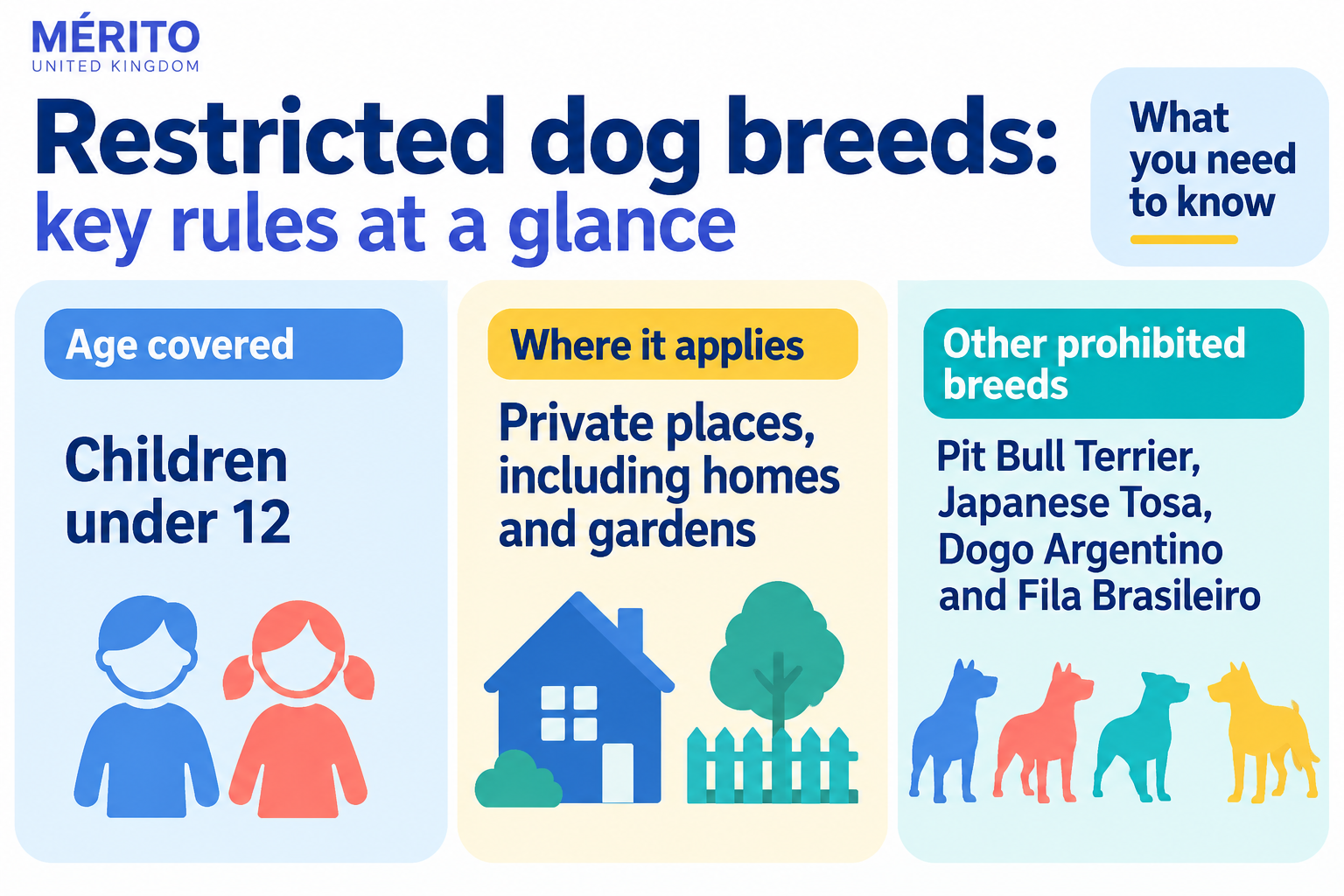
Since 1 November 2026, an owner must not leave a child under 12 in close contact with an XL Bully in a private place, such as a home or garden, without adult supervision. The requirement is a condition of the dog’s Certificate of Exemption, rather than a general ban on children being present around dogs.
The official guidance specifies that the measure applies in England and Wales. It concerns close contact in a private setting and adult supervision; the guidance does not set a distance threshold for “close contact”.
The existing exemption framework
The XL Bully is one of five prohibited breeds in the UK, alongside the Pit Bull Terrier, Japanese Tosa, Dogo Argentino and Fila Brasileiro. In England and Wales, an XL Bully may be kept only with a valid Certificate of Exemption. Reports estimate that about 61,000 certificates were issued; the official guidance does not give a total.
Certificate holders must meet other conditions, including keeping the dog muzzled and on a lead in public, securing it against escape and ensuring it is neutered. Owners must provide the certificate within five days when requested by a police constable or authorised local authority officer. The new child-supervision requirement adds a safeguard for private settings.
Under the official guidance, failure to follow the exemption requirements means the dog is no longer exempt and could be taken by police; the owner could also be prosecuted. New exemptions can only be authorised by a court order.
Enforcement and the change’s context
The government statement says owners who breach the new condition could have their dog seized and face up to six months in prison. Accounts differ on the potential fine, and the official guidance supplied does not specify a fine for breaching this condition, so no monetary amount is stated here.
The condition was added to an exemption framework introduced after XL Bullies became subject to restrictions. It does not make every XL Bully illegal to keep: owners with a valid exemption may continue to keep their dog if they meet the applicable requirements. The guidance records that it became a criminal offence to own or possess an XL Bully without a valid Certificate of Exemption in England and Wales.
Explore the background
Further reading
Selected background resources to explain the context and concepts behind this story.
Understand the legal framework and judicial interpretation of the Dangerous Dogs Act 1991 and the Certificate of Exemption scheme.
This official judiciary document provides authoritative context on how the Dangerous Dogs Act 1991 and the exemption schemes are applied and interpreted in England, offering a stable legal reference for the regulation mentioned in the article.
Review the legislative history and parliamentary scrutiny regarding the addition of the XL Bully to the list of prohibited dog types.
Tenth Report
As a report from the UK Parliament, this resource documents the formal process and rationale behind the 2023 ban on XL Bullies, providing essential background on the regulatory landscape in which the new supervision condition operates.
Identify the specific responsibilities and policy areas of the Department for Environment, Food and Rural Affairs (Defra).
Department for Environment, Food & Rural Affairs 2024-25
This overview from the National Audit Office clarifies the role of Defra, the government department responsible for the policy in question, helping readers understand the institutional authority behind the regulation.
External links selected for their educational value. They are separate from the sources used to report this story.
Editorial transparency
Article integrity
These checks apply to the published version. Changes to its content or evidence require a fresh review.
Veracidad
Aprobado
Comprueba que la pieza tenga fuentes declaradas y verificadas, que el nivel de evidencia se presente correctamente y que el desarrollo sea suficiente para sostener sus afirmaciones.
100/100
Analizado 01/11/2026 07:30 · rules-v1
Ausencia de sesgo
Aprobado
Busca lenguaje emocional, descalificaciones, generalizaciones absolutas y una voz editorial impropia de una noticia. También comprueba atribuciones y pluralidad de fuentes cuando la materia es sensible.
100/100
Analizado 01/11/2026 07:30 · rules-v1
Ausencia de clickbait
Aprobado
Evalúa si el titular cuenta el hecho principal sin ocultarlo para provocar curiosidad, sin promesas exageradas y sin recursos tipográficos engañosos.
100/100
Analizado 01/11/2026 07:30 · rules-v1
Coherencia editorial
Aprobado
Contrasta titular, subtítulo, resumen y cuerpo para detectar contradicciones, cifras sin respaldo o un alcance mayor del que permite la información disponible.
100/100
Analizado 01/11/2026 07:30 · rules-v1
Plagio y originalidad
Aprobado
Compara la prosa con los extractos de las fuentes utilizadas y con hasta 250 publicaciones recientes de Mérito para detectar copia extensa o una reescritura demasiado cercana.
100/100
Analizado 01/11/2026 07:30 · rules-v1
Conflictos de interés
Aprobado
Analiza posibles relaciones entre la autoría, el medio y las fuentes, así como patrocinio, lenguaje promocional o dependencia exclusiva de comunicados de prensa.
100/100
Analizado 01/11/2026 07:30 · rules-v1
The score is a quality-control indicator, not a probability that something is true.