UN mission says strike on Ukraine aid site may have violated humanitarian law
Civilians had gathered at a former school in Komyshuvakha to receive aid when glide bombs struck on 2 November 2026; dozens were reported missing.
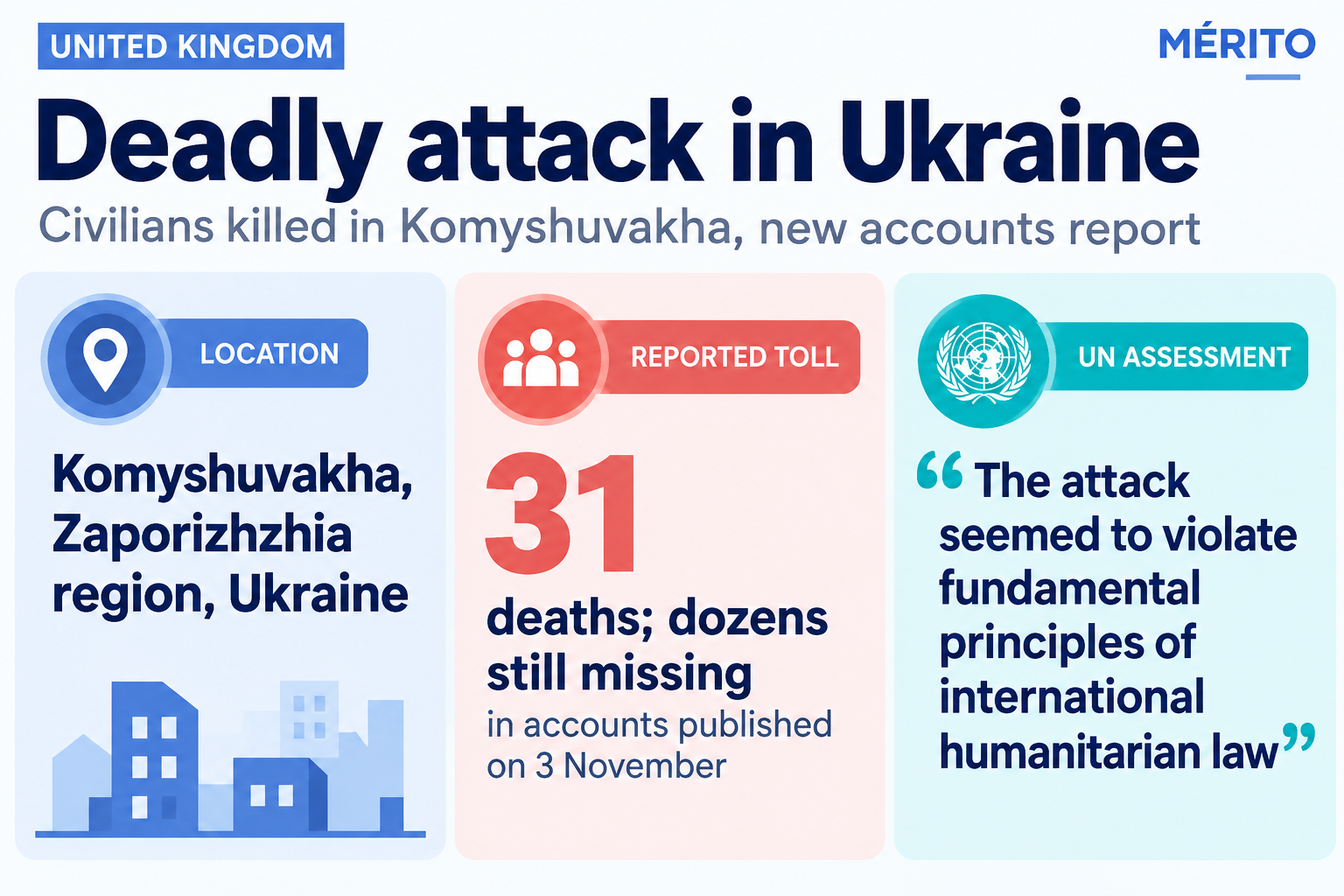
A Russian strike hit a former school used as a humanitarian aid distribution site in Komyshuvakha, in Ukraine’s Zaporizhzhia region, on 2 November 2026. Ukrainian officials reported 31 deaths and dozens missing. The UN human-rights monitoring mission said the attack seemed to violate fundamental principles of international humanitarian law.
The strike hit a site used to distribute humanitarian aid in Komyshuvakha on 2 November 2026.
Strike on the aid distribution site
On 2 November 2026, Russian strikes hit a former school in Komyshuvakha, in Ukraine’s Zaporizhzhia region, where residents had gathered to receive humanitarian aid. The building was being used as a distribution point and shelter, rather than as a school for pupils.
The UN Human Rights Monitoring Mission in Ukraine said powerful aerial glide bombs struck the school building while civilians were gathered there. Local authorities had announced the aid distribution the previous day, giving its location and scheduled time.
Ukrainian officials reported that 31 people had been killed by 3 November and that dozens remained missing. Rescuers and volunteers were searching the rubble. The available accounts gave differing estimates of the missing, so the number is not specified here.
The mission said the attack seemed to have violated the most fundamental principles of international humanitarian law. This was its qualified assessment of the incident, not a judicial finding.
Russia’s defence ministry said the attack had targeted Ukrainian military units and killed 25 servicemen. The supplied accounts did not establish that the site was being used by the military; the claim remains disputed.
Wider overnight strikes and energy damage
The Komyshuvakha strike took place during a wider wave of overnight attacks. Ukrainian President Volodymyr Zelensky said Russia launched 289 attack drones, 17 ballistic missiles and 59 cruise missiles across nine regions, triggering emergency power cuts.
Ukraine’s energy ministry said Russia carried out 20 strikes in 10 regions overnight, damaging energy infrastructure and causing electricity outages. The figures describe the ministry’s account of the wider strikes, rather than the attack on the aid site alone.
Explore the background
Further reading
Selected background resources to explain the context and concepts behind this story.
Understand the monitoring role and mandate of the UN Human Rights Monitoring Mission in Ukraine.
Supporting Justice and Accountability in Ukraine
The extract says the mission monitors and reports on human rights, helping readers distinguish its role from that of other UN bodies.
Understand the scale and categories of damage and recovery needs in Ukraine.
Ukraine Rapid Damage and Needs Assessment (RDNA3)
The World Bank assessment concerns damage and needs across sectors including energy and transport, providing background on the wider effects of the war beyond this particular strike.
External links selected for their educational value. They are separate from the sources used to report this story.
Editorial transparency
Article integrity
These checks apply to the published version. Changes to its content or evidence require a fresh review.
Veracidad
Aprobado
Comprueba que la pieza tenga fuentes declaradas y verificadas, que el nivel de evidencia se presente correctamente y que el desarrollo sea suficiente para sostener sus afirmaciones.
100/100
Analizado 03/11/2026 17:28 · rules-v1
Ausencia de sesgo
Aprobado
Busca lenguaje emocional, descalificaciones, generalizaciones absolutas y una voz editorial impropia de una noticia. También comprueba atribuciones y pluralidad de fuentes cuando la materia es sensible.
100/100
Analizado 03/11/2026 17:28 · rules-v1
Ausencia de clickbait
Aprobado
Evalúa si el titular cuenta el hecho principal sin ocultarlo para provocar curiosidad, sin promesas exageradas y sin recursos tipográficos engañosos.
100/100
Analizado 03/11/2026 17:28 · rules-v1
Coherencia editorial
Aprobado
Contrasta titular, subtítulo, resumen y cuerpo para detectar contradicciones, cifras sin respaldo o un alcance mayor del que permite la información disponible.
100/100
Analizado 03/11/2026 17:28 · rules-v1
Plagio y originalidad
Aprobado
Compara la prosa con los extractos de las fuentes utilizadas y con hasta 250 publicaciones recientes de Mérito para detectar copia extensa o una reescritura demasiado cercana.
100/100
Analizado 03/11/2026 17:28 · rules-v1
Conflictos de interés
Aprobado
Analiza posibles relaciones entre la autoría, el medio y las fuentes, así como patrocinio, lenguaje promocional o dependencia exclusiva de comunicados de prensa.
100/100
Analizado 03/11/2026 17:28 · rules-v1
The score is a quality-control indicator, not a probability that something is true.