Scotland’s rail network recovers after Storm Boelo
After planned closures and speed restrictions, teams cleared debris, repaired infrastructure and checked routes before services resumed.
Rail teams worked through Sunday night to restore services after Storm Boelo, clearing fallen trees and debris, repairing overhead lines and inspecting routes. Earlier closures affected lines in western and northern Scotland, with reduced speeds elsewhere; passengers were warned to expect disruption and longer journeys.
Planned closures and reduced speeds were followed by clearance, repairs and route inspections.
Closures and speed restrictions during the storm
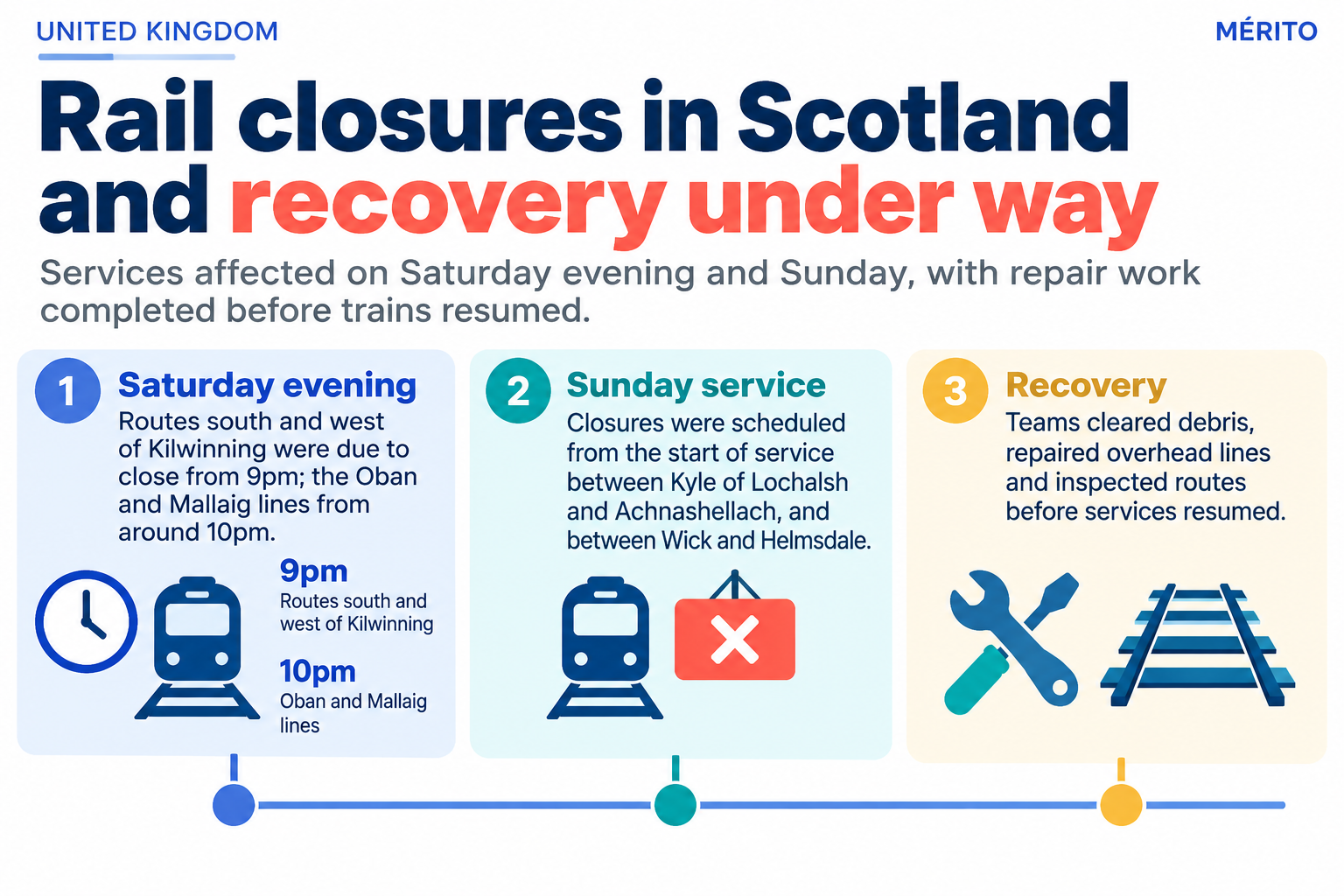
During Storm Boelo, planned railway closures affected routes in western and northern Scotland. Services south and west of Kilwinning were due to stop from 9pm on Saturday, while the Oban and Mallaig lines were scheduled to close from about 10pm.
From the start of service on Sunday, closures were planned between Kyle of Lochalsh and Achnashellach, and on the Wick–Helmsdale section. Trains across large parts of Scotland were also scheduled to run at reduced speeds from late Saturday evening into Sunday.
Network Rail advised passengers to expect significant disruption and longer journeys, and to plan ahead and check their journey before setting off. The closures and speed restrictions were safety measures intended to reduce risks from strong winds, including trees or debris on the tracks and damage to railway equipment.
Teams worked to restore services
After the storm, rail teams worked through Sunday evening and overnight to clear fallen trees and debris from tracks, repair damaged overhead lines and address flooding and power failures at locations across the network.
Routes had to be checked for obstructions and damage before trains could return. Inspections were carried out overnight using specialist equipment and, where needed, a helicopter, as teams prepared affected lines to reopen safely.
Most train services in Scotland were expected to run normally on Monday morning, but disruption could continue on some routes. Passengers were advised to check before travelling, particularly on services between Inverness and Kyle of Lochalsh, Inverness and Thurso or Wick, Glasgow Queen Street and Fort William or Oban, and Ayr and Stranraer.
Explore the background
Further reading
Selected background resources to explain the context and concepts behind this story.
Understand how Scotland’s railway plans for weather resilience and climate-change impacts.
Scotland's Railway
Network Rail’s plan is explicitly about weather resilience and climate adaptation, providing useful infrastructure context for storm-related inspections and repairs.
Learn about the strategic priorities and planning framework for Scotland’s railway.
Strategic Business Plan
This strategic business plan sets out an industry-level view of the railway in Scotland, helping place operational recovery within broader rail planning.
Explore how Britain’s railway system developed and how its organisation changed over time.
Collection of Material relating to Early Railways in Britain
The archive description notes the 1948 transfer of the railways to the British Transport Commission and the creation of British Railways, offering historical context for today’s network.
Understand the role of formal rail-accident investigation in examining railway safety events.
Rail Accident Report
This is a published Rail Accident Report concerning Carmont; it offers a reference point on railway investigation, though it is not about Storm Boelo or weather recovery.
External links selected for their educational value. They are separate from the sources used to report this story.
Editorial transparency
Article integrity
These checks apply to the published version. Changes to its content or evidence require a fresh review.
Veracidad
Aprobado
Comprueba que la pieza tenga fuentes declaradas y verificadas, que el nivel de evidencia se presente correctamente y que el desarrollo sea suficiente para sostener sus afirmaciones.
100/100
Analizado 28/10/2026 00:37 · rules-v1
Ausencia de sesgo
Aprobado
Busca lenguaje emocional, descalificaciones, generalizaciones absolutas y una voz editorial impropia de una noticia. También comprueba atribuciones y pluralidad de fuentes cuando la materia es sensible.
100/100
Analizado 28/10/2026 00:37 · rules-v1
Ausencia de clickbait
Aprobado
Evalúa si el titular cuenta el hecho principal sin ocultarlo para provocar curiosidad, sin promesas exageradas y sin recursos tipográficos engañosos.
100/100
Analizado 28/10/2026 00:37 · rules-v1
Coherencia editorial
Aprobado
Contrasta titular, subtítulo, resumen y cuerpo para detectar contradicciones, cifras sin respaldo o un alcance mayor del que permite la información disponible.
100/100
Analizado 28/10/2026 00:37 · rules-v1
Plagio y originalidad
Aprobado
Compara la prosa con los extractos de las fuentes utilizadas y con hasta 250 publicaciones recientes de Mérito para detectar copia extensa o una reescritura demasiado cercana.
100/100
Analizado 28/10/2026 00:37 · rules-v1
Conflictos de interés
Aprobado
Analiza posibles relaciones entre la autoría, el medio y las fuentes, así como patrocinio, lenguaje promocional o dependencia exclusiva de comunicados de prensa.
100/100
Analizado 28/10/2026 00:37 · rules-v1
The score is a quality-control indicator, not a probability that something is true.