Scottish Parliament rejects Reform UK motion on face-covering restrictions
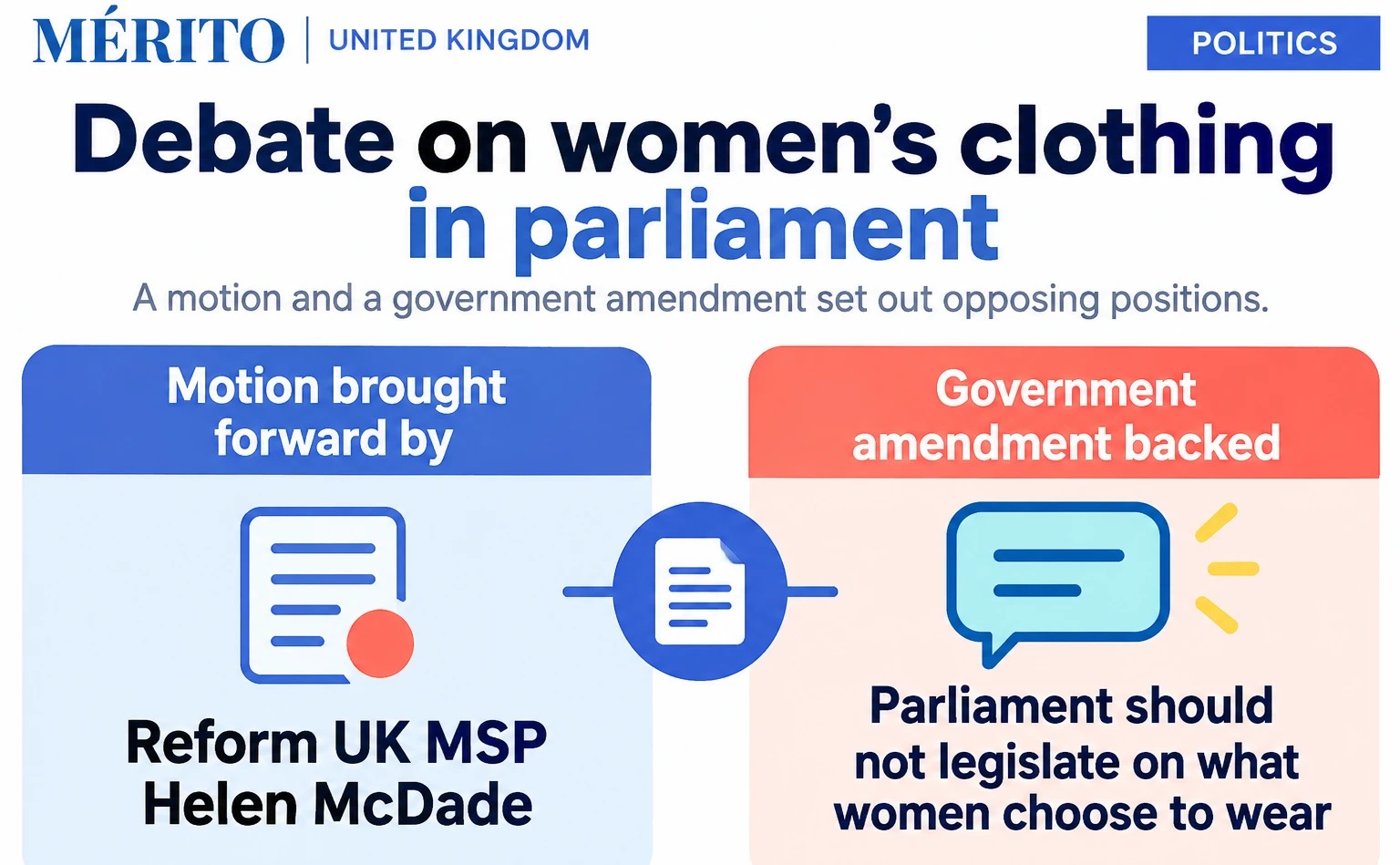
MSPs backed a government amendment saying Parliament should not legislate on what women choose to wear.
The Scottish Parliament rejected a Reform UK motion seeking consideration of further restrictions on full-face coverings in public places, including the burqa and niqab. The debate also addressed police powers concerning face coverings used to conceal identity during crime or disorder.
The motion and the government amendment backed at Holyrood.
The motion and the decision
The Scottish Parliament rejected a Reform UK motion brought forward by MSP Helen McDade. It asked for consideration of further restrictions on full-face coverings in public places, including the burqa and niqab, and referred to possible benefits for public safety, individual liberty and community cohesion.
MSPs backed a government amendment stating that it was not for Parliament to legislate on what women choose to wear. The amendment also called on parliamentarians to reject language and actions that divide Scotland’s communities, in person and online. The motion called for consideration of restrictions; it did not itself introduce a ban.
Reform MSP Thomas Kerr argued that face coverings should be prohibited in public places, saying he did not care whether the covering was a balaclava or a burqa. Community Safety Minister Kirsten Oswald opposed legislation on women’s clothing and criticised the motion for referring to the burqa and niqab but not other coverings such as balaclavas. These were opposing arguments in the debate, not changes to the motion’s outcome.
Police powers and separate proposals
The motion acknowledged that police in Scotland already have powers to require people to remove face coverings in certain circumstances connected with criminality or disorder. The Scottish Government’s stated position was that existing police powers are sufficient to deal with people concealing their identities in connection with criminality or disorder.
Scottish Conservative MSP Stephen Kerr proposed a separate amendment focused on face coverings used to conceal identities during criminal activity or serious public disorder. It called for a review of existing police powers and consideration of additional measures where there were reasonable grounds to require someone to remove a face covering; it did not specifically seek restrictions on religious dress.
Thomas Kerr’s support for banning both burqas and balaclavas was distinct from Stephen Kerr’s proposal. Stephen Kerr’s amendment addressed concealment of identity linked to crime or serious disorder, rather than religious clothing.
Explore the background
Further reading
Selected background resources to explain the context and concepts behind this story.
Understand the legislative process and the distinct roles of the Scottish Parliament and the Scottish Government.
How Parliament Works
This official page explains how MSPs examine and pass laws on devolved matters, providing the necessary institutional context to understand how a motion like the one rejected in the article is processed within the Scottish Parliament.
Identify the primary legislation governing police powers and public order in Scotland.
Police, Public Order and Criminal Justice (Scotland) Act 2006
The article discusses police powers regarding face coverings during crime or disorder. This resource provides the text and summary of the Police, Public Order and Criminal Justice (Scotland) Act 2006, which is the foundational statute for these powers.
Learn the specific legal criteria and procedures for police stop and search powers in Scotland.
Stop and Search
As the debate touched on police powers to address identity concealment, this guide from Police Scotland offers a clear, non-news explanation of when and how stop and search powers are legally exercised, helping readers understand the operational side of the issue.
Gain an academic overview of the origins and political trajectory of Reform UK.
The 2024 General Election and the Rise of Reform UK
This academic paper from Royal Holloway provides a stable, research-based context on the party's formation and rise, helping readers understand the political background of the party that proposed the motion, without relying on current news reports.
External links selected for their educational value. They are separate from the sources used to report this story.
Editorial transparency
Article integrity
These checks apply to the published version. Changes to its content or evidence require a fresh review.
Veracidad
Aprobado
Comprueba que la pieza tenga fuentes declaradas y verificadas, que el nivel de evidencia se presente correctamente y que el desarrollo sea suficiente para sostener sus afirmaciones.
100/100
Analizado 05/11/2026 01:30 · rules-v1
Ausencia de sesgo
Aprobado
Busca lenguaje emocional, descalificaciones, generalizaciones absolutas y una voz editorial impropia de una noticia. También comprueba atribuciones y pluralidad de fuentes cuando la materia es sensible.
100/100
Analizado 05/11/2026 01:30 · rules-v1
Ausencia de clickbait
Aprobado
Evalúa si el titular cuenta el hecho principal sin ocultarlo para provocar curiosidad, sin promesas exageradas y sin recursos tipográficos engañosos.
100/100
Analizado 05/11/2026 01:30 · rules-v1
Coherencia editorial
Aprobado
Contrasta titular, subtítulo, resumen y cuerpo para detectar contradicciones, cifras sin respaldo o un alcance mayor del que permite la información disponible.
100/100
Analizado 05/11/2026 01:30 · rules-v1
Plagio y originalidad
Aprobado
Compara la prosa con los extractos de las fuentes utilizadas y con hasta 250 publicaciones recientes de Mérito para detectar copia extensa o una reescritura demasiado cercana.
100/100
Analizado 05/11/2026 01:30 · rules-v1
Conflictos de interés
Aprobado
Analiza posibles relaciones entre la autoría, el medio y las fuentes, así como patrocinio, lenguaje promocional o dependencia exclusiva de comunicados de prensa.
100/100
Analizado 05/11/2026 01:30 · rules-v1
The score is a quality-control indicator, not a probability that something is true.